
How to Stop an IRS Levy, 7 Steps to a Levy Release
Direct answer: You may be able to stop an IRS levy by responding before the deadline on the final notice, requesting a timely Collection Due Process hearing, resolving the balance through an installment agreement, proving immediate economic hardship, correcting an IRS error, or obtaining another approved collection resolution.
If a levy has already reached your bank, employer, customer, or payment processor, contact the IRS immediately and request a formal levy release.
A Final Notice of Intent to Levy is not a notice to set aside for later. By the time it arrives, the IRS has usually sent prior collection notices and waited through its normal response periods. The IRS may be preparing to take wages, money in a bank account, business receivables, or other property to collect the balance.
The good news is that you may still have options. The result often depends on the type of notice, the date printed on it, whether a levy has already been served, and whether you can support the requested resolution with accurate financial information.
The most important deadline is the date shown on the Final Notice of Intent to Levy and Notice of Your Right to a Hearing. A timely request for a Collection Due Process hearing generally suspends levy action for the liabilities listed on the notice while the hearing and any related appeal remain pending.
There are limited exceptions, so read the notice carefully and act by the stated deadline.
I have seen taxpayers lose useful appeal rights because they waited for another letter, called the wrong IRS department, or assumed a bank or wage levy would stop on its own. It will not.
This guide explains seven practical steps that can help you protect your appeal rights, request an IRS levy release, and move the account into a long term tax debt resolution.

Brief Summary
An IRS levy is the legal seizure of property or rights to property to collect a tax debt. A levy can reach wages, bank accounts, business receivables, retirement income, and other assets.
An LT11 or Letter 1058 generally gives you the right to request a Collection Due Process hearing by the deadline printed on the notice. A timely request can protect important appeal rights and generally suspends levy action for the listed tax periods while the hearing is pending.
A bank levy usually freezes the funds that were available when the bank received the levy. The bank generally holds those funds for 21 days before sending them to the IRS.
A wage levy works differently. It generally continues from one pay period to the next until the IRS releases it, the balance is paid, the collection period ends, or another ending event applies.
A levy may be released when the debt is paid, the collection period has expired, the levy was improper, an approved installment agreement does not allow the levy to continue, the levy is causing qualifying economic hardship, or another legal release condition applies.
The correct response depends on the notice, the tax years, the collection stage, your filing compliance, and your financial circumstances.

Step 1, Understand What the Notice Means and How Much Time You Have
The IRS uses several collection notices before it takes money or property. The wording on the notice tells you whether the IRS is warning about a possible levy or has already sent a levy to a third party.
The Difference Between a Levy Warning and an Active Levy
The IRS commonly sends several collection notices before issuing a levy.
The notice that usually provides formal hearing rights before a levy is titled Final Notice of Intent to Levy and Notice of Your Right to a Hearing. It may be identified as LT11 or Letter 1058.
This final notice does not necessarily mean the IRS has already taken money from your bank account or paycheck. It means the IRS intends to levy if the balance is not resolved and gives you a deadline to request a Collection Due Process hearing.
A Notice of Levy sent to your bank, employer, customer, payment processor, or another third party is different. That document means the levy has already been served.
At that point, your focus shifts from preventing the levy to securing a release before more money is transferred.
Confusing these two stages can cost you valuable time. Start by identifying the exact notice and whether a third party has already received levy paperwork.
The Deadline Printed on the Notice Controls
Read the notice and identify the exact deadline for requesting a hearing. Do not estimate the deadline from memory.
Use the date printed on the notice and follow the submission instructions provided by the IRS.
A timely Collection Due Process request generally suspends levy action for the tax periods listed on the notice while IRS Appeals reviews the case. It may also preserve the right to ask the United States Tax Court to review the final determination.
If the deadline has passed, an Equivalent Hearing may still be available if requested within the applicable period.
However, an Equivalent Hearing does not generally suspend levy action and does not provide the same right to petition the Tax Court.
The Two Common Levy Types and Why Timing Differs
A bank levy reaches funds held in the account when the financial institution receives the levy.
The bank generally freezes those funds and waits 21 days before sending them to the IRS. Deposits made after the bank receives the levy are generally not captured by that specific bank levy.
A wage levy is usually continuous. It reaches wages and similar income as they are paid until the IRS issues a release, the tax is paid, the collection period ends, or another release condition applies.
Knowing which type of levy you face determines what you should do first.

Step 2, Take Immediate Action Within 24 to 48 Hours
Once you understand the notice, begin confirming the account information and contacting the correct IRS department.
Do not wait until the response deadline or the end of the bank holding period.
Read the Notice and Confirm Every Detail
Start by confirming the taxpayer name, tax year or years, type of tax, amount shown, notice number, response deadline, and the IRS office handling the account.
Compare the notice with your IRS Online Account and available account transcripts.
The balance may include tax, penalties, and interest. It may also involve a tax year you thought was resolved or a payment that was not properly credited.
Keep the original notice. Scan it or save a clear digital copy.
You may need it when speaking with the IRS, preparing Form 12153, or working with a representative.
Call the Number Printed on the Notice First
The best number is usually the telephone number printed on the notice or levy.
That number is more likely to connect you with the IRS function handling the account.
For general individual account assistance, the IRS telephone number is 800 829 1040.
For business accounts, the IRS Business and Specialty Tax Line is 800 829 4933.
When you reach the IRS, explain the notice you received, whether a levy has already been served, and what resolution you are requesting.
Do not agree to a monthly payment until you have reviewed your actual income, necessary expenses, assets, and ability to pay.
Do Not Wait for Another IRS Letter
Do not assume the IRS will send another warning after an LT11 or Letter 1058.
A missed hearing deadline can reduce your procedural options.
If a bank has already frozen funds, the 21 day holding period may be running.
If an employer has received a wage levy, payroll may begin withholding after the employer processes the levy instructions.
Act first. Sort out the complete resolution immediately after the urgent collection issue is controlled.
Keep a Written Record of Every IRS Contact
Record the date and time of every call, the IRS department, the employee name and identification number, what was discussed, what documents were requested, where they must be sent, and the date you were told to follow up.
Keep proof of every fax, upload, and mailing.
IRS departments do not always have immediate access to documents sent elsewhere. Your own records may be the fastest way to prove what was submitted and when.
Step 3, Choose the Right IRS Levy Relief Option
Your income, assets, expenses, filing compliance, tax type, and collection stage determine which resolution option fits.
A strategy that works for one taxpayer may not work for another.
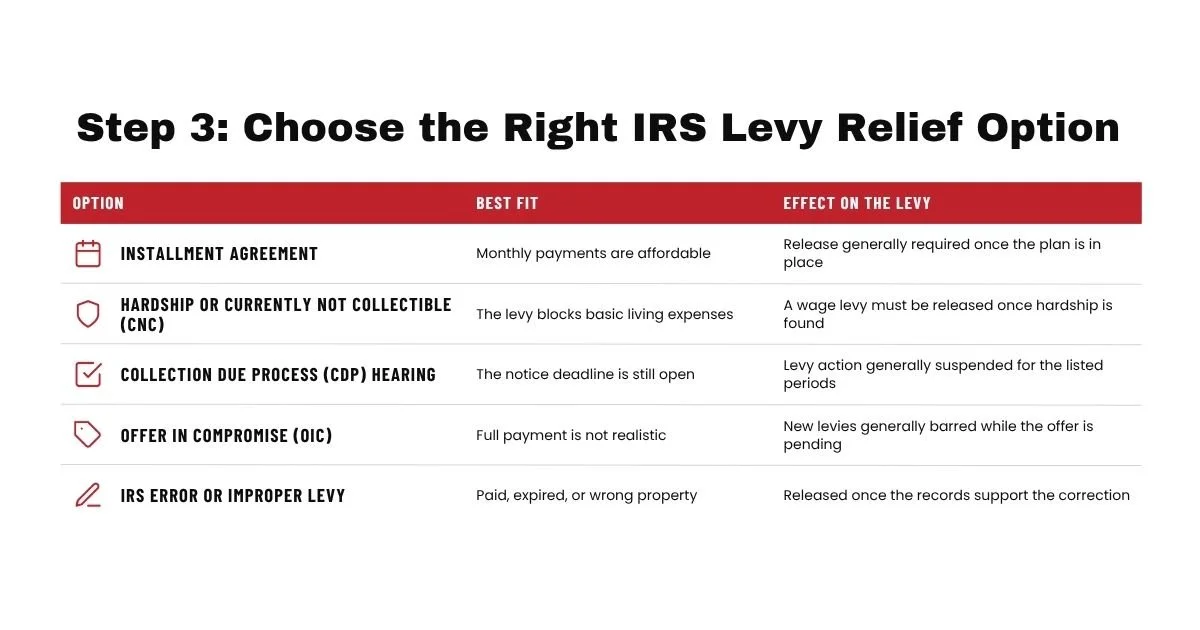
The main levy relief options include an installment agreement, hardship release, Currently Not Collectible status, a Collection Due Process hearing, an Offer in Compromise, or correction of an IRS error.
Installment Agreement for a Manageable Balance
If you can afford monthly payments, an installment agreement may provide a direct path to resolving the debt.
The IRS is generally required to release a levy when you enter an installment agreement and the terms of that agreement do not allow the levy to continue.
However, do not assume an existing bank or wage levy has been released simply because a payment plan was discussed or approved.
Confirm that the IRS issued the levy release to the bank, employer, or other third party.
When timing is urgent, have the correct fax number available and ask when the release will be transmitted.
Penalties and interest generally continue until the balance is paid.
The monthly payment should be based on a realistic review of your finances, not on pressure to end the call.
Hardship Levy Release and Currently Not Collectible Status
If the levy prevents you from paying basic and reasonable living expenses, explain that the levy is causing immediate economic hardship.
The IRS generally requires financial information before making a hardship determination.
You may need to provide income, necessary expenses, assets, bank balances, household information, and supporting records.
A wage levy that creates immediate economic hardship must be released once the IRS makes that determination.
A bank or other account levy that creates immediate economic hardship may also qualify for release.
Currently Not Collectible status may pause active collection when the IRS determines that you cannot pay without preventing necessary living expenses.
It does not erase the debt.
Penalties and interest may continue, tax refunds may be applied to the balance, and the IRS may review your finances later.
Collection Due Process Hearing for Formal Review
Use Form 12153 to request a Collection Due Process hearing or Equivalent Hearing when the notice provides those rights.
A timely Collection Due Process request generally suspends levy action for the liabilities listed on the notice.
During the hearing, you may be able to propose an installment agreement, Offer in Compromise, hardship status, or another collection alternative.
You may also raise certain challenges to the underlying tax liability if you did not receive a statutory notice of deficiency and did not otherwise have a prior opportunity to dispute the liability.
A timely hearing request does not automatically guarantee that money already frozen under a bank levy will be released.
If a levy has already been served, make a separate and direct levy release request.
Offer in Compromise for Tax Debt That Cannot Be Fully Paid
An Offer in Compromise may settle qualifying tax debt for less than the full amount owed when the IRS determines that full collection is not realistic or another authorized basis applies.
The IRS generally cannot issue a new levy while a processable offer is pending, during the 30 day period after rejection, or while a timely appeal of the rejection is pending.
An Offer in Compromise does not automatically release a levy that attached before the offer was submitted.
In uncommon cases, a continuous wage levy that attached before the offer became pending may remain in place during the offer review.
For that reason, an active levy should be addressed directly.
Do not file an offer only to delay collection.
Correcting an IRS Error or Improper Levy
A levy may be improper because the debt was paid, the collection period expired, the property belongs to someone else, the IRS violated a legal restriction, or the levy involved another error.
Provide clear records supporting the correction.
This may include payment confirmation, account transcripts, ownership records, bankruptcy information, or proof that a timely appeal was pending.
If the IRS denies a request to release the levy, appeal rights may be available through the Collection Appeals Program or another procedure, depending on the facts.

Step 4, Prepare the Forms and Documents Needed for Fast Action
The IRS makes most collection decisions based on the information and records available.
Having the correct forms and documents ready can reduce delays and help the IRS understand the requested resolution.
Form 12153, Request for a Collection Due Process or Equivalent Hearing
Send Form 12153 to the address or fax number shown for hearing requests on the final notice.
Do not send it to a general IRS address or the payment address unless the notice directs you to do so.
Include a copy of the notice.
Identify the tax periods, the collection action you are appealing, the resolution you are requesting, and the reasons for your request.
Keep a complete copy and proof of timely submission.
Certified mail, an approved private delivery service, fax confirmation, or another verifiable submission method may help establish when the request was sent.
Form 433 A, Form 433 F, or Form 433 B
The IRS may ask for a collection information statement to evaluate an installment agreement, hardship request, Currently Not Collectible status, or another financial resolution.
Form 433 A is commonly used for wage earners and self employed individuals.
Form 433 F may be used in certain collection cases.
Form 433 B is used for business financial information.
The correct form depends on the IRS department, the taxpayer type, and the resolution being requested.
Use the form requested by the IRS and answer every applicable question accurately.
Financial Records That Support Your Request
Be prepared to provide recent bank statements, pay statements, proof of housing costs, utilities, transportation, health insurance, medical expenses, court ordered payments, secured debt, business income and expenses, and information about assets.
The IRS may compare claimed expenses with its Collection Financial Standards.
Amounts above the standards may still be allowed when they are necessary and properly supported.
Do not submit incomplete financial information when the missing records affect the result.
A rushed and unsupported request can delay the release or lead to a payment amount you cannot maintain.
Form 668 D, Release of Levy
Form 668 D is the IRS release sent to the bank, employer, or other levy source.
You do not prepare the IRS release yourself.
Once the IRS approves the release, confirm where and when it was sent.
Ask the bank or employer to confirm receipt.
A verbal statement that the account is resolved does not stop withholding or transfer by itself.
The third party generally needs the IRS release or other official direction.

Step 5, Act Before Bank Funds Transfer or Another Paycheck Is Reduced
The timing of a bank levy is different from the timing of a wage levy.
Understanding the difference can help you focus on the most urgent action.
How the 21 Day Bank Levy Holding Period Works
When a bank receives an IRS levy, it generally freezes funds in the account at that time and holds them for 21 days before sending them to the IRS.
That holding period allows time to contact the IRS, arrange payment, report an error, or request a levy release.
It is not a 21 day extension of every appeal deadline.
Call the IRS as soon as you learn about the bank levy.
Ask the bank for the date it received the levy, the amount frozen, the scheduled transfer date, and the fax number used for levy releases.
An installment agreement, hardship determination, or correction may support a release, but the bank should receive the formal release before the holding period ends.
Why Wage Levies Require Immediate Formal Action
A wage levy generally continues from one pay period to the next.
Your employer must follow the levy until the IRS releases it or another ending condition applies.
A portion of wages is exempt based on federal rules.
The employer provides a statement for filing status and dependents.
Complete and return that statement promptly because failure to return it can reduce the exempt amount.
Every pay period the levy remains active may mean another reduced paycheck.
If the levy prevents you from meeting basic living expenses, request an immediate hardship review and provide complete financial information.
What Happens After Money Is Sent to the IRS
A levy release stops future transfer of property covered by the release.
It does not automatically return money that has already been sent to the IRS.
In some circumstances, the IRS may return levy proceeds or property.
The rules depend on whether the levy was wrongful, erroneous, premature, or otherwise qualifies for return.
If money has already been transferred, ask the IRS which return of levy proceeds procedure applies and what deadline controls.
A third party who owns the property may have a different claim from the taxpayer who owes the tax.

Step 6, Decide Whether to Call the IRS Yourself or Use Representation
Some levy cases can be handled directly by the taxpayer.
Other cases involve several tax years, legal deadlines, disputed balances, business taxes, or financial hardship that may benefit from professional representation.
When a Direct IRS Call May Be Enough
You may be able to handle the matter directly when the balance is manageable, all required returns are filed, the facts are clear, and you know which payment or hardship option you are requesting.
Prepare before calling.
Know the monthly amount you can actually afford, the documents available, and whether you need a temporary collection hold while a formal request is reviewed.
Do not make financial statements from memory.
The IRS may rely on what you say when evaluating a payment plan or hardship request.
When Professional Representation May Help
Professional representation may be useful when the case involves multiple unfiled returns, a large balance, several tax years, business payroll taxes, a Revenue Officer, a bank levy already in progress, a continuous wage levy, a disputed liability, an appeal deadline, or a rejected resolution request.
An attorney, Certified Public Accountant, or Enrolled Agent who is authorized to practice before the IRS may use Form 2848 to represent you for the tax matters and periods listed on the authorization.
Representation does not create a special levy release rule.
It can help organize the records, communicate with the correct IRS function, identify procedural rights, and present a complete resolution request.
How I Handle IRS Levy Cases at Semper Tax Relief
I begin by reviewing the notice, account transcripts, filing history, collection status, levy source, appeal deadlines, and financial circumstances.
The immediate goal is to identify whether the levy can be prevented, released, appealed, or limited.
The long term goal is to resolve the tax debt so the collection problem does not return.
As an IRS Enrolled Agent and Juris Doctor with nearly 20 years of tax experience, I represent taxpayers before IRS Collection and Appeals.
I do not recommend an installment agreement, hardship request, or Offer in Compromise until I understand the complete account and the taxpayer's ability to pay.
Step 7, Take the Next Concrete Step
An IRS levy is serious, but it is not always the end of your options.
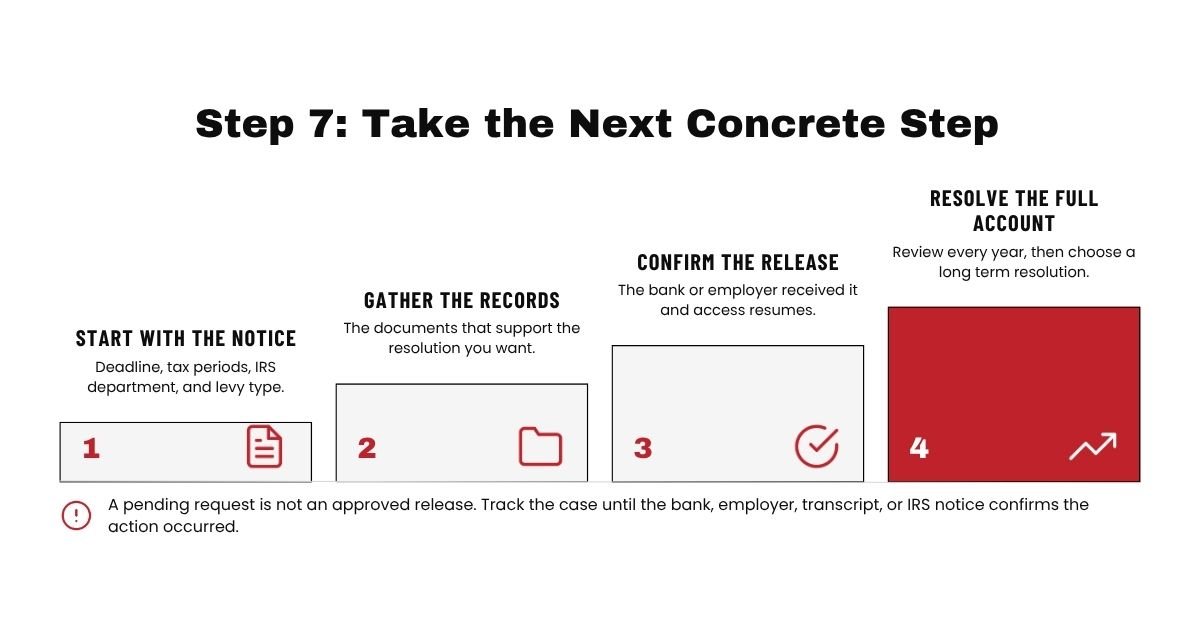
Start with the notice.
Identify the deadline, the tax periods, and the IRS department.
Confirm whether you have a proposed levy, a bank levy, a wage levy, or another collection action.
Next, gather the documents that support your request.
Decide whether the immediate goal is a hearing request, payment plan, hardship release, correction, or another collection resolution.
Then track the case until the bank, employer, transcript, or IRS notice confirms that the requested action occurred.
Do not mistake a pending request for an approved release.
Review the Entire IRS Account
The levy may be connected to more than one tax year or notice.
Review account transcripts, filing history, payments, penalties, interest, collection assignments, and the remaining collection period.
Resolving only the levy without reviewing the entire account can lead to another collection action later.
Confirm That the Levy Was Actually Released
After the IRS approves a release, confirm that the bank, employer, customer, or payment processor received the release.
Ask the third party when normal account access, payroll processing, or payments will resume.
Keep a copy of the release confirmation with your IRS records.
Choose a Long Term Tax Debt Resolution
A levy release handles the immediate collection action.
It does not necessarily resolve the underlying tax debt.
The next step may involve an installment agreement, Currently Not Collectible status, an Offer in Compromise, penalty relief, an appeal, corrected tax returns, or another resolution.
If you received an LT11, Letter 1058, Form 668 A, Form 668 W, bank levy, wage levy, or another urgent collection notice, Semper Tax Relief offers a free case review.
I can review the IRS account and explain the next appropriate step.
For a broader explanation of payment plans, Currently Not Collectible status, Offer in Compromise, penalty relief, appeals, and the collection statute, review the Ultimate IRS Tax Debt Resolution Guide.
Frequently Asked Questions About How to Stop an IRS Levy
-
The IRS can transmit a levy release quickly after it approves the request, especially when the bank or employer fax number is available.
The time needed to approve the release depends on the reason for the request, the IRS department handling the account, and whether financial records or management approval are required.
A hardship request may require detailed financial information before the IRS makes a decision.
A clear error may be corrected faster when the taxpayer provides proof.
After approval, confirm that the IRS sent the release and that the bank or employer received it.
-
An installment agreement may stop future levy action and can require release of an existing levy when the agreement terms do not allow the levy to continue.
However, discussing a payment plan does not release a levy.
Confirm that the agreement is approved and that the IRS issued Form 668 D or other official release instructions to the bank, employer, or third party.
Penalties and interest generally continue while the agreement is active.
-
The 21 day holding period is the time a bank generally waits after receiving an IRS levy before sending the frozen funds to the IRS.
The levy usually reaches the funds available when the bank receives it.
Deposits made later are generally not included in that specific levy.
During the holding period, contact the IRS to request a release, report an error, arrange payment, or provide hardship information.
-
No.
A timely Form 12153 generally suspends levy action for the liabilities listed on the final notice while the Collection Due Process hearing is pending.
However, it does not automatically guarantee the release of funds already frozen under a bank levy.
If a bank levy has already been served, contact the IRS separately and request a formal release.
Provide the bank fax number and explain the legal, financial, or procedural basis for the request.
-
You may still be able to request an Equivalent Hearing within the applicable period shown in the Form 12153 instructions.
An Equivalent Hearing allows IRS Appeals to review many of the same collection issues.
However, it does not generally suspend levy action, and you cannot petition the United States Tax Court to review the Equivalent Hearing decision.
Other options, including the Collection Appeals Program, a payment plan, hardship request, or liability correction, may still be available.
-
The IRS may ask for recent bank statements, pay statements, proof of rent or mortgage, utilities, transportation, food, health insurance, medical costs, court ordered payments, secured debts, and information about assets.
Self employed taxpayers may also need current profit and loss information, business bank statements, accounts receivable, payroll records, and proof of current tax deposits.
The records should show why the levy prevents payment of basic and reasonable living expenses.
-
A wage levy is generally continuous.
It can remain in effect from one pay period to the next until the IRS releases it, the tax is paid, the collection period expires, or another ending condition applies.
Part of the paycheck is exempt from levy.
The exempt amount depends on federal rules and the information provided to the employer.
If the levy creates immediate economic hardship, contact the IRS and request a hardship release.
-
Possibly.
The IRS may return levy proceeds or property in certain situations, including some wrongful, erroneous, or premature levies.
The procedure and deadline depend on who owns the property, why the levy was improper, and when the levy occurred.
Contact the IRS promptly, request the correct administrative claim procedure, and keep proof of ownership, account records, and all levy documents.