What Happens If You Have Unfiled Tax Returns and How to Fix Them
Haven't filed a tax return in years? Learn what happens with IRS penalties and substitute returns, and how to file old returns and resolve the tax debt.
Unfiled tax returns usually become harder to correct when they are ignored. The IRS may charge penalties, hold a refund, send notices requesting the missing returns, prepare a substitute for return, and eventually begin collection action if tax is assessed and remains unpaid.
The solution usually begins with filing compliance. I first identify which returns are missing, obtain the available IRS transcripts, reconstruct the records, prepare accurate returns, and determine whether any deadlines require immediate attention. Once the returns are filed, the remaining tax debt can be addressed separately.
You should file required past due tax returns even when you cannot pay the full balance. Filing and paying are two separate obligations. The IRS states that most payment plans and tax relief options require the missing returns to be filed first.
I am Sergio Melendez, an IRS Enrolled Agent and Juris Doctor. I began working in the tax field in 2005 and have spent nearly two decades handling IRS tax problems for individuals and businesses. As an Enrolled Agent, I am authorized to represent taxpayers before the IRS. That experience has taught me that the best way to address IRS unfiled returns is to separate the filing problem from the payment problem and deal with each one in the correct order.

Brief Summary
Unfiled tax returns do not normally disappear because time passes. If a required return was never filed, the IRS can assess tax through its substitute for return process, and the normal three year assessment period does not begin until the taxpayer later files a return.
The main takeaways are:
File required returns even if you cannot pay the balance.
Confirm which years are actually missing before preparing anything.
Use IRS account transcripts and wage and income transcripts to rebuild missing information.
Protect refund years before the refund claim deadline expires.
Do not assume an IRS substitute for return reflects the correct tax.
Respond to IRS notices using the instructions and address shown on the notice.
Restore tax return compliance before requesting most payment or settlement options.
Consider penalty relief only after the facts and filing history have been reviewed.
Acting Now Compared With Continuing to Wait
Criteria | File the Returns Now | Continue Waiting
Failure to file penalty | Filing stops additional months from being added to the failure to file period | The penalty may continue growing until it reaches the applicable limit
Refund rights | A timely filed past due return may preserve an available refund | A refund can be permanently lost after the refund claim period expires
Substitute for return | Your return can report the correct filing status, expenses, credits, and deductions | The IRS may calculate tax using the income information available to it
Payment options | Filing compliance may make payment plans and other relief options available | Many IRS resolution options remain unavailable while required returns are missing
Collection risk | You can address the true assessed balance after processing | An IRS prepared assessment can lead to collection notices, a levy, or a federal tax lien if unpaid
The IRS states that the failure to file penalty for individuals and many business returns is generally 5 percent of the unpaid tax for each month or part of a month the return is late, up to 25 percent. The IRS may also hold refunds, prepare a substitute return, and begin collection after an assessment remains unpaid.
How I Evaluated the Risks and Solutions
I prepared this guide as a research based explanation rather than a promotional service page.
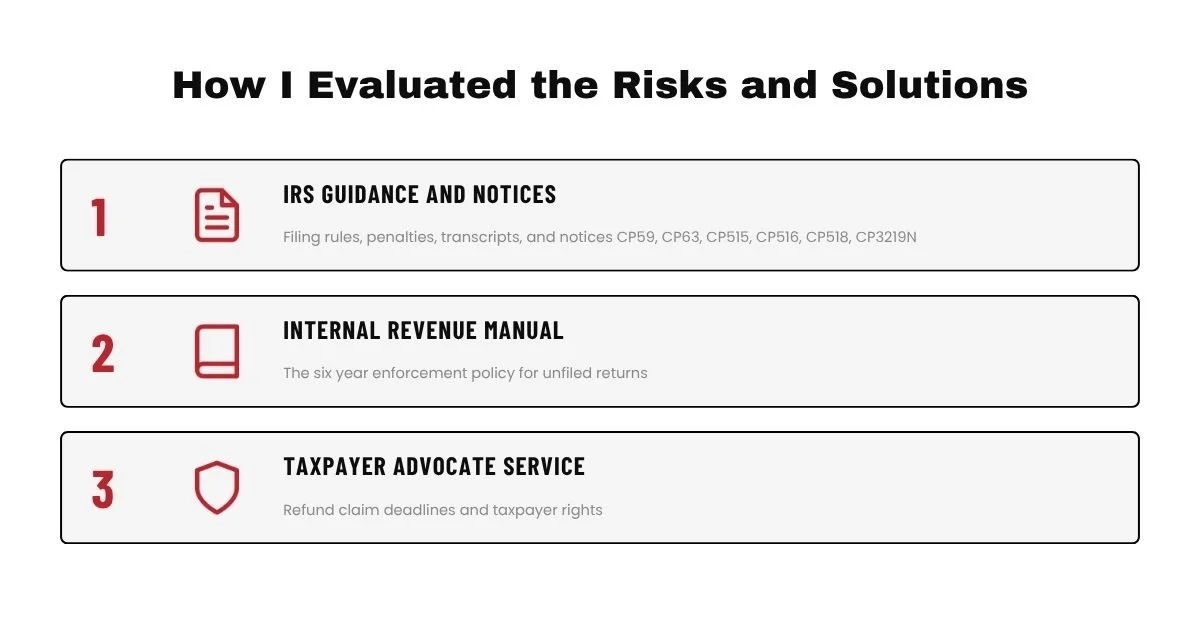
I reviewed current IRS guidance for filing past due tax returns, the failure to file penalty, refund claim deadlines, IRS transcript access, substitute for return procedures, payment options, and penalty relief.
I also reviewed current IRS pages for notices CP59, CP63, CP515, CP516, CP518, and CP3219N. These pages explain how the IRS communicates with taxpayers at different stages of an unfiled return case.
For the question of how far back the IRS may require returns, I reviewed the Internal Revenue Manual. The manual states that enforcement of filing requirements will normally cover a six year period, although the IRS may require more or fewer years when the facts support a different determination and managerial approval is obtained.
For refund deadlines and taxpayer rights, I reviewed guidance from the Taxpayer Advocate Service. TAS warns that a taxpayer who files after the refund statute expiration date generally loses the overpayment and cannot apply it to another tax year.
What Happens If You Have Unfiled Tax Returns
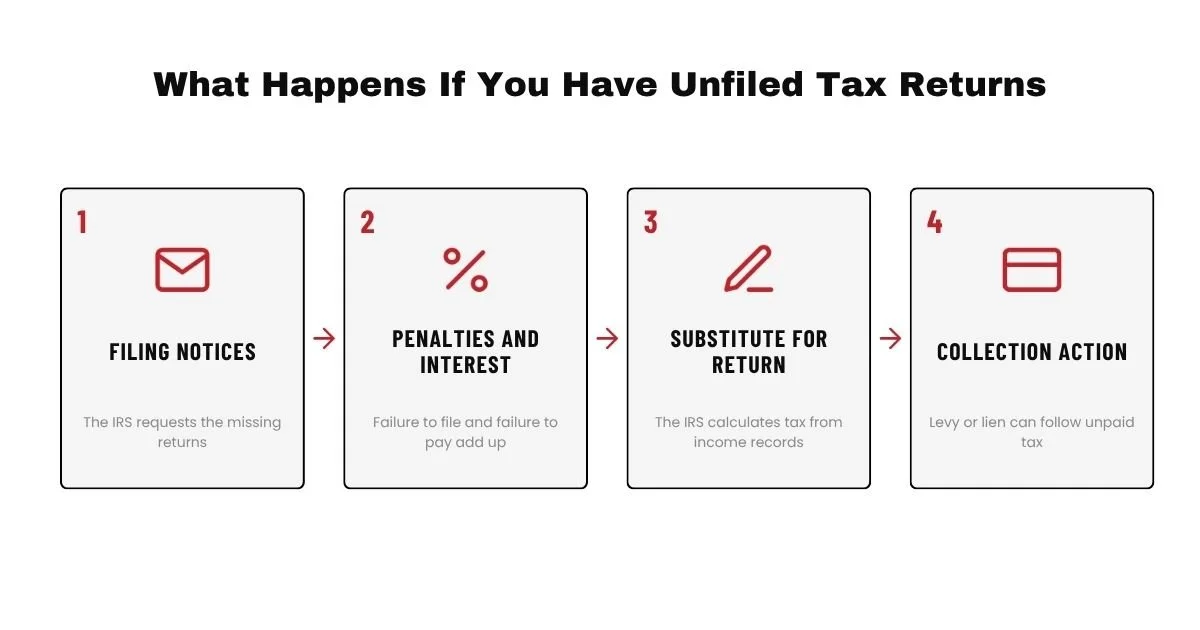
When I review an unfiled return case, I separate the possible consequences into four areas. These are filing notices, penalties, IRS prepared assessments, and collection action.
Not every case reaches every stage. The result depends on whether a return was required, whether tax is due, how many years are missing, whether the IRS has already sent notices, and whether the IRS has already prepared a substitute for return.
The IRS May Send Notices Requesting the Returns
The IRS compares filed tax returns with income records received from employers, banks, investment companies, payment processors, and other reporting sources.
When the IRS believes a required return is missing, it may send an IRS notice for unfiled tax returns. The early notice may ask you to file, provide a copy of a return already filed, or explain why you were not required to file.
Ignoring the notice does not establish that no return was required. It usually moves the account further into the IRS nonfiler process.
Penalties and Interest May Increase the Balance
If a return is late and tax is due, the IRS may assess a failure to file penalty. The IRS can also charge a failure to pay penalty when the tax was not paid by the original payment deadline.
Interest generally applies to unpaid tax and can also apply to certain penalties. Filing the return does not erase existing interest, but it stops additional months from being added to the failure to file period.
The IRS May Hold a Refund
A current refund may be held when IRS records show that one or more prior returns are missing.
For example, a CP63 notice may state that the IRS is holding a refund until the missing returns are filed or the taxpayer provides an acceptable explanation showing that no return was required.
If a missing return shows additional tax due, the IRS may apply some or all of the held refund to that balance.
The IRS May Prepare a Substitute for Return
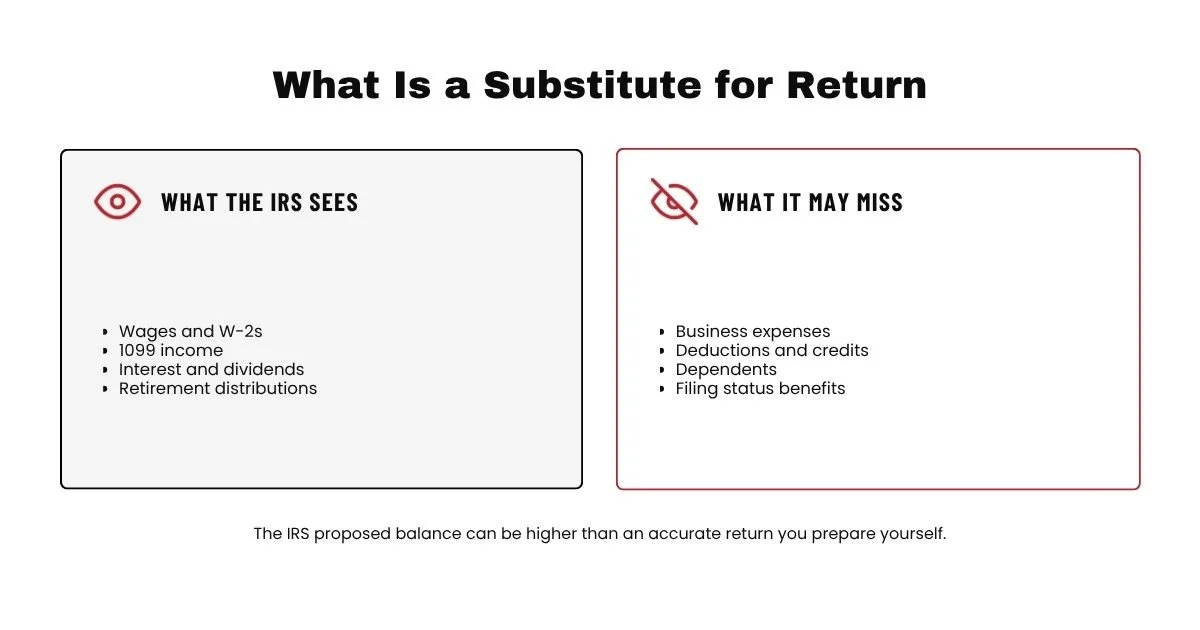
The IRS can calculate tax using wages and other income reported by third parties. The resulting substitute for return may not include all expenses, deductions, filing status benefits, dependents, or credits that could appear on a properly prepared return.
The IRS may then issue CP3219N, a Notice of Deficiency. This notice generally provides 90 days to file a petition with the United States Tax Court, or 150 days when the notice is addressed to a person outside the United States. Filing a return does not extend the Tax Court petition deadline.
An Assessment Can Lead to IRS Collection
Once the IRS assesses tax, it can send balance due notices and begin the collection process if the amount remains unpaid.
Depending on the facts and required notice procedures, collection may include a levy on wages or a bank account, or the filing of a Notice of Federal Tax Lien.
This does not mean every unfiled return immediately leads to wage garnishment or a lien. The return must first produce or lead to an assessed balance, and the IRS must generally follow its collection notice procedures. Still, unfiled tax returns and wage garnishment can become connected when the filing problem develops into unpaid assessed tax.
Who Is Required to File a Tax Return
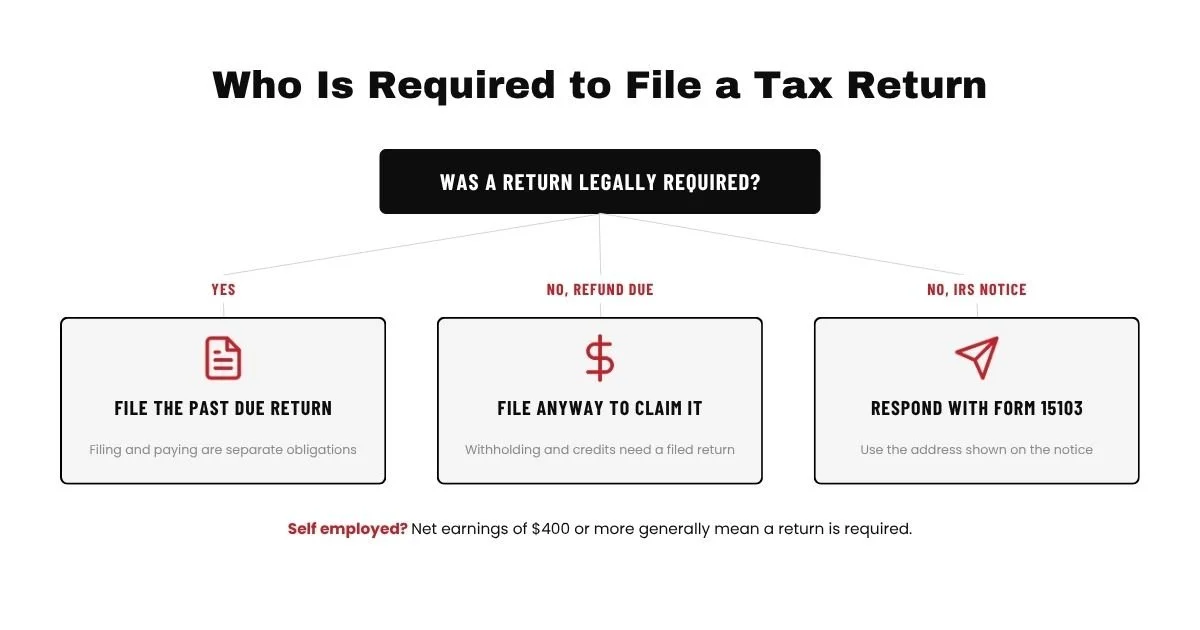
A missing return creates a compliance issue only when a return was legally required.
For individuals, the filing requirement can depend on gross income, filing status, age, dependency status, self employment income, and certain special tax situations. The income thresholds change, so each missing year should be reviewed using the rules that applied to that specific year.
Low Income Does Not Always Mean No Filing Requirement
A person may have a filing requirement even when income seems low.
For example, self employed individuals generally must file when net earnings from self employment are $400 or more. Other rules may apply when a person received advance premium tax credits, owes special taxes, received distributions from certain accounts, or qualifies as a dependent.
You May Want to File Even When Filing Is Not Required
A person who was not required to file may still benefit from filing.
A return may be needed to claim federal income tax withholding, estimated tax payments, the Earned Income Tax Credit, the Additional Child Tax Credit, or another refundable credit.
Before deciding that an old return does not matter, I check whether the taxpayer could be owed money and whether the refund claim period is still open.
Respond If the IRS Is Wrong About the Filing Requirement
An IRS notice does not always mean a return was legally required.
If you were not required to file, follow the instructions on the notice. Some notices allow the taxpayer to submit Form 15103 and explain why no return was required.
Keep a copy of the response and proof of delivery. Do not send the explanation to a general IRS address when the notice provides a specific response address, fax number, or online response method.

Penalties for Unfiled Tax Returns
The amount added to an account depends on the return type, the amount of unpaid tax, how late the return is, and whether penalty relief applies.
I do not estimate penalties based only on the age of the return. I first determine the correct tax, payments, withholding, credits, filing date, and prior compliance history.
Failure to File Penalty
For individuals and many business income tax returns, the failure to file penalty is generally 5 percent of the unpaid tax for each month or part of a month the return is late. The penalty generally reaches its maximum at 25 percent.
When the failure to file and failure to pay penalties apply during the same month, the failure to file penalty is generally reduced by the failure to pay penalty amount for that month.
A minimum late filing penalty may apply when a return is more than 60 days late. The applicable minimum depends on the due date of the return.
Failure to Pay Penalty
The failure to pay penalty is separate from the failure to file penalty.
It is generally based on unpaid tax that was not paid by the original payment deadline. An extension to file does not create an extension to pay.
This is why I recommend filing even when payment is not available. Filing can stop the larger failure to file penalty from continuing, while the taxpayer works on a plan for the unpaid taxes.
Late Business Return Penalties
Unfiled business tax returns can create a different type of exposure.
Late partnership and S corporation return penalties may be based on the number of partners or shareholders and the number of months the return is late. A business can face a substantial penalty even when the entity return does not show income tax due.
Payroll tax returns, corporate income tax returns, partnership returns, and S corporation returns should be reviewed separately because each has different filing and penalty rules.
Penalty Relief for Late Filing
Penalty relief may be available, but it is not automatic.
The IRS may consider reasonable cause when the taxpayer used ordinary care but could not file or pay on time. Possible facts may include serious illness, death in the immediate family, a natural disaster, inability to obtain essential records, or certain system problems.
Each year and each penalty must be evaluated based on its own facts. A general statement that life was difficult is usually not enough. The explanation should connect the event to the filing failure and include records that support the timeline.
The IRS also identifies circumstances that generally do not establish reasonable cause by themselves, including lack of knowledge, lack of funds, ordinary mistakes, or reliance on a tax professional.
What Is a Substitute for Return
A substitute for return is an IRS prepared tax assessment process used when a taxpayer does not voluntarily file a required return.
It is important to understand that the IRS is not preparing the return in the same way your own tax professional would prepare it. The IRS is using the information available in its system to calculate a proposed liability.
How the IRS Calculates the Proposed Tax
The IRS may use wages, interest, dividends, retirement distributions, payment processor records, and other information reported under your Social Security number or taxpayer identification number.
The IRS may calculate tax, penalties, and interest from those records and send a CP3219N Notice of Deficiency.
The notice gives the taxpayer a limited period to challenge the proposed assessment in Tax Court. If the taxpayer disagrees with the amount, filing an accurate return by the date shown on the notice may allow the IRS to consider the correct figures.
Why the IRS Calculation May Be Too High
Third party reporting usually shows income. It does not always show the full cost of earning that income.
For a self employed taxpayer, the IRS may see Forms 1099 but may not know about ordinary business expenses. The IRS may also lack information about dependents, filing status, basis, capital losses, education expenses, or other items that affect the final tax.
This is one reason a substitute for return can produce a higher balance than a complete taxpayer prepared return.
Can an IRS Substitute for Return Be Corrected
In many cases, yes.
The IRS states that even after it prepares a substitute return, it is generally still in the taxpayer’s interest to file an accurate return. The IRS will generally adjust the account to reflect the correct figures after reviewing and processing the taxpayer’s return.
The procedure becomes more difficult after assessment because the return may need to be reviewed as a request to reconsider or adjust the substitute assessment. Processing can also take longer.
If a CP3219N deadline is still open, protect the Tax Court deadline separately. Sending a return to the IRS does not pause or extend the time to petition the Tax Court.
How Far Back Can the IRS Go for Unfiled Tax Returns
People often hear that they only need to file six years. That statement needs context.
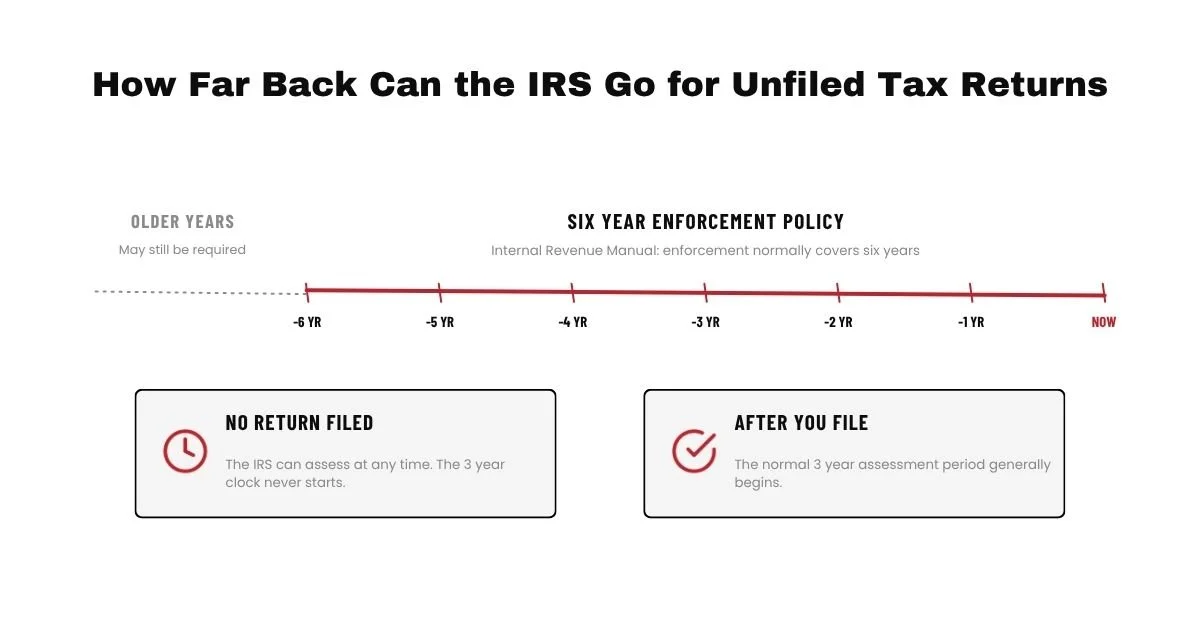
The six year filing policy is an IRS enforcement guideline. It is not a statute that automatically erases every return older than six years.
The Normal Assessment Period Does Not Begin Without a Return
The IRS can usually assess tax within three years after a return is due or, when filed late, within three years after the IRS receives it, whichever date is later.
When a required return was not voluntarily filed, the IRS states that it may assess tax at any time through the substitute for return program. An IRS prepared substitute return does not start the normal three year assessment period. If the taxpayer later files a valid return, the three year period generally begins at that point.
The IRS Six Year Enforcement Policy
The Internal Revenue Manual states that enforcement of filing requirements will normally be pursued for a six year period.
The manual also says the IRS should request all nonfraudulent unfiled returns and that a taxpayer may file returns for all open periods, regardless of the age of the delinquency.
Requiring more or fewer than six years may depend on the facts and generally requires managerial approval. Some return types, including partnership and S corporation returns, receive separate treatment under the enforcement policy.
Why the Correct Filing Period Depends on the Case
I evaluate the filing period using several questions:
Which returns were legally required?
Has the IRS issued a notice for a specific year?
Has the IRS already prepared a substitute for return?
Is a refund claim deadline close to expiring?
Do earlier returns affect later carryovers, basis, losses, or credits?
Is the case assigned to a revenue officer?
Are business, payroll, partnership, or S corporation returns involved?
The practical compliance period may often center on six years, but the correct answer should come from the account history and applicable return requirements.

Can You Lose a Refund From an Old Tax Return
Yes. A taxpayer can permanently lose an otherwise valid refund by filing too late.
The general refund claim rules are different from the IRS assessment rules. A year can remain open for the IRS to assess tax while the taxpayer’s ability to claim a refund has already expired.
The General Three Year Refund Rule
The IRS generally requires a past due return claiming withholding, estimated payments, or refundable credits to be filed within three years of the return due date.
The exact refund limit can depend on when the return is filed and when the tax was considered paid. Certain exceptions may apply, so refund deadlines should be calculated rather than estimated.
The Taxpayer Advocate Service warns that when a return is filed after the applicable refund statute expiration date, the IRS generally will not issue the refund, the overpayment is forfeited, and it cannot be applied to another year.
Refund Holds Caused by Missing Returns
The IRS may hold a refund when its records show that a prior tax return is missing.
A CP63 or CP88 notice may identify the missing year and explain that the current refund is being held. Filing the missing return, or proving that no return was required, may allow the IRS to complete the refund review.
If the missing return produces a tax balance, the IRS may apply the held refund to that debt.
Self Employment Income and Social Security Credits
An unfiled return can also affect a self employed person’s Social Security record.
The IRS explains that when self employment income is not reported on a federal return, that income may not be reported to the Social Security Administration. The taxpayer may lose credit connected to future retirement or disability benefits.

How to Fix Unfiled Tax Returns
I use a step by step process because filing several old returns without first reviewing the IRS account can create avoidable errors.
The goal is not simply to send forms. The goal is to determine the correct filing requirement, prepare accurate returns, protect deadlines, and confirm that the IRS processes each return correctly.
Step 1, Identify Every Missing Return
Start with your own records, prior tax returns, tax software history, and IRS Online Account.
An IRS account transcript can show whether a return posted, whether the IRS prepared a substitute return, whether tax was assessed, and whether payments or credits were applied.
Do not assume that a year is unfiled simply because you cannot locate a copy. Confirm the IRS record.
Step 2, Obtain IRS Transcripts
A wage and income transcript can provide information reported to the IRS on Forms W 2, Forms 1099, Forms 1098, and other information returns.
The IRS states that wage and income transcripts are generally available for the past ten tax years. Current year information may be incomplete while reporting is still being processed.
Transcripts are useful, but they may not contain everything required for an accurate return. State wage information may be limited, and transcripts usually do not provide the business expenses, basis records, or supporting documents needed to claim deductions.
Step 3, Reconstruct Missing Records
Collect available bank statements, payroll records, bookkeeping reports, invoices, receipts, mortgage statements, brokerage statements, health insurance forms, and prior year depreciation schedules.
For a business or self employed taxpayer, income reconstruction should be coordinated with expense reconstruction. Reporting all third party income without reviewing the expenses can produce an overstated result.
When records are unavailable, reasonable reconstruction methods may be possible, but the method should be consistent and supported by the available evidence.
Step 4, Prioritize Urgent Years
Several missing years do not always have the same level of urgency.
I usually look first for:
An open CP3219N deadline
A refund claim period close to expiring
A year with an IRS substitute assessment
A year connected to an active levy or collection case
An older return needed to calculate later losses, credits, or basis
A business return that affects owners or shareholders
Preparing the years in chronological order is often logical, but an active statutory deadline may require a different order.
Step 5, Prepare Accurate Returns
Use the correct tax forms, instructions, tax law, and filing status for each year.
Do not prepare an old return using current year forms or current year tax rules. Credits, deductions, standard deduction amounts, filing thresholds, and business rules change by year.
Review each return against the IRS transcript to identify missing income documents or reporting differences before filing.
Step 6, File the Returns in the Correct Place
The IRS says a past due return is generally filed in the same manner and at the same location as an on time return. However, when the IRS has sent a notice, the return should be sent to the location stated in that notice.
The IRS currently accepts electronic filing for the two most recent prior years through providers that offer prior year e filing. Older returns are generally mailed or submitted under the instructions for the active notice or IRS unit handling the case.
Keep a complete signed copy and proof of submission for every year.
Step 7, Monitor IRS Processing
Filing the return is not the end of the process.
Monitor the account transcript to confirm that the return posted, the correct tax was assessed, payments were applied properly, and any substitute for return figures were adjusted.
Paper returns and substitute return corrections can require additional processing time. If the return was sent in response to a notice, keep the notice, response form, delivery confirmation, and a copy of the signed return together.
Several Years of Unfiled Tax Returns
When someone has several years of missing tax returns, I treat each tax year as a separate file within one larger compliance project.
Each year may have different income sources, filing requirements, penalties, refunds, notices, and collection status.
How to File Back Taxes for Multiple Years
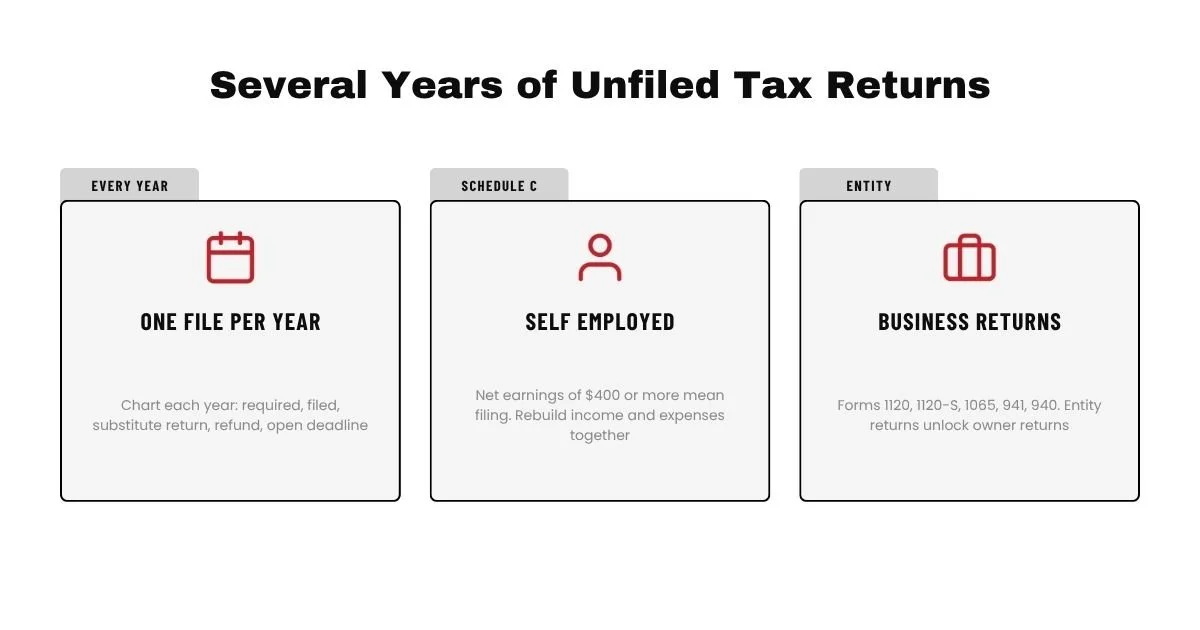
Begin by creating a year by year filing chart.
For each year, record:
Whether a return was required
Whether the IRS shows a return on file
Whether a substitute for return was assessed
Whether a refund may be available
Whether a notice deadline is open
Which documents are available
The estimated tax balance or refund
How the year affects later returns
This creates a clear order of work and reduces the chance of filing one year correctly while overlooking an earlier year that changes the result.
Unfiled Tax Returns for Self Employed Taxpayers
Self employed taxpayers often face a larger reconstruction project because the IRS may have information showing gross payments but little information showing business expenses.
A person with net earnings from self employment of $400 or more generally has a federal filing requirement, even when the business was part time or operated as a side job.
Bank deposits should not automatically be treated as taxable gross receipts. Transfers, loans, owner contributions, refunds, and other nontaxable deposits should be identified. At the same time, business expenses should be supported as well as the available records permit.
Unfiled Business Tax Returns
Business return problems may include:
Form 1120 corporate returns
Form 1120 S corporation returns
Form 1065 partnership returns
Form 941 employment tax returns
Form 940 federal unemployment returns
Information returns such as Forms 1099
These returns have different penalties, filing requirements, and IRS processing procedures.
Partnership and S corporation returns are especially important because missing entity returns can prevent owners from accurately filing their personal returns. The late filing penalties may also be calculated based on the number of partners or shareholders.

IRS Notices for Unfiled Tax Returns
The notice number helps identify where the case is in the IRS process.
Read the full notice, confirm the taxpayer name and identification number, verify the tax year, and note the response deadline before taking action.
IRS Notice CP59
CP59 generally means the IRS has no record of a prior personal income tax return and believes a return may be required.
The response may include filing the return, providing information showing the return was already filed, or explaining why there was no filing requirement.
Form 15103 may be used with the response. Follow the address, fax number, or online response instructions stated on the notice.
IRS Notice CP63
CP63 generally concerns a refund being held because one or more prior returns appear to be missing.
The IRS may release the refund after it receives the required returns or accepts an explanation showing that the taxpayer did not have to file.
If the missing return shows unpaid taxes, the IRS may apply all or part of the refund to that balance.
IRS Notices CP515, CP516, and CP518
CP515 is a reminder that the IRS has no record of a prior return and believes a return is required.
CP516 generally follows an earlier notice and states that the IRS still has no record of the return.
CP518 is described by the IRS as a final reminder. It warns that the IRS may determine the tax, that penalties and interest may continue, and that a refund may be delayed.
These notices should be answered using the instructions for the specific notice.
IRS Notice CP3219N
CP3219N is a Notice of Deficiency connected to an unfiled return.
The IRS has calculated proposed tax, penalties, and interest using income reported by employers, financial institutions, and other sources.
If you disagree, the notice states that you may file the return by the date shown. You also have a limited period to petition the United States Tax Court.
Do not treat the return filing deadline and Tax Court petition deadline as the same procedure. Filing a return does not extend the Tax Court deadline.
What If You Cannot Pay After Filing
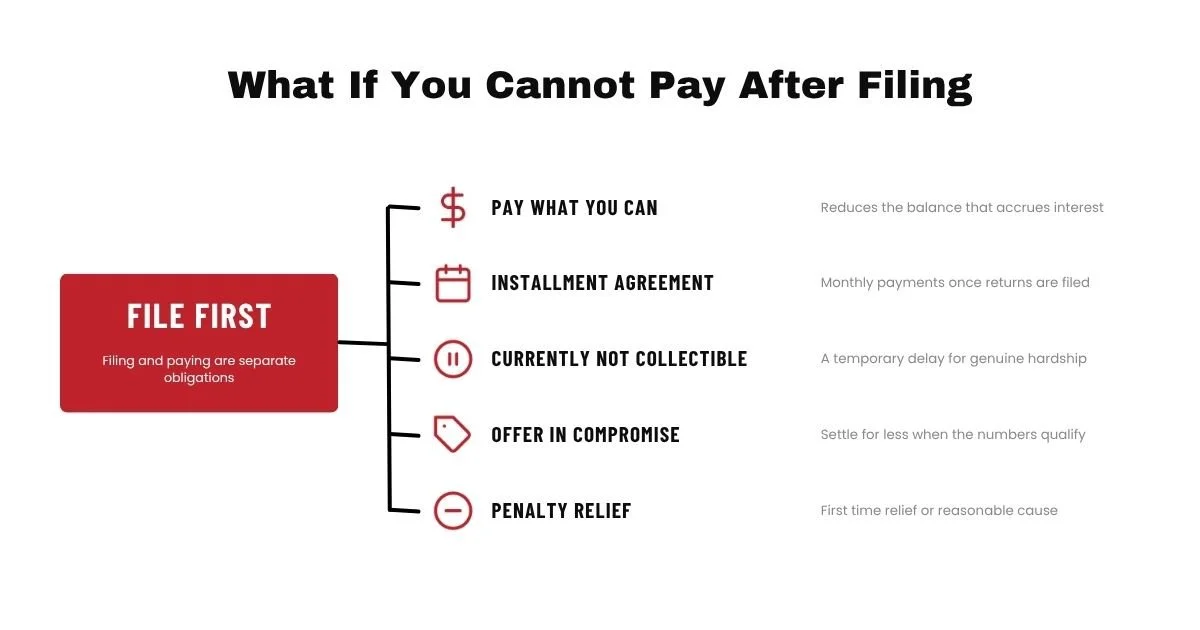
You should generally file required returns even when you cannot pay the balance in full.
The IRS states that you do not need to pay the entire amount immediately to file, and that filing missing returns is the first step in resolving tax debt. Most payment plans and relief options require filing compliance.
Pay What You Can
A partial payment reduces the unpaid principal on which additional interest and certain penalties may continue.
Do not use money needed for basic living expenses without first understanding the available collection options and the effect of the payment.
Installment Agreement for Back Taxes
An installment agreement allows eligible taxpayers to pay an IRS balance over time.
Online long term payment plan eligibility for individuals generally requires all required returns to be filed. Eligibility also depends on the amount owed and other account facts.
Before agreeing to a monthly amount, review income, necessary expenses, assets, current tax withholding, and estimated tax obligations. A payment plan that cannot be maintained may default and return the account to collection.
Temporary Collection Delay
A taxpayer who cannot pay basic living expenses may qualify for a temporary collection delay, commonly called currently not collectible status.
The IRS may request financial information and may require past due returns. Taxpayer Advocate guidance notes that the IRS can place an account in hardship status in some situations even when returns are missing, but the IRS may still request those returns.
This status does not remove the debt. Interest and applicable penalties generally continue, and the IRS may review the taxpayer’s finances later.
Offer in Compromise
An offer in compromise may settle tax debt for less than the full amount when the taxpayer qualifies.
The IRS reviews ability to pay, income, expenses, and asset equity. The taxpayer generally must file all required returns and make required current estimated tax payments before applying.
An offer in compromise is not available simply because the debt is large. The financial calculation, legal liability, collection period, current compliance, and hardship facts all matter.
Penalty Relief
After the correct returns are filed and processed, review the account for first time penalty relief, reasonable cause, or another administrative basis for relief.
Penalty relief should be requested using accurate facts and supporting records. Removal of a penalty may also result in a related reduction of interest charged on that penalty.
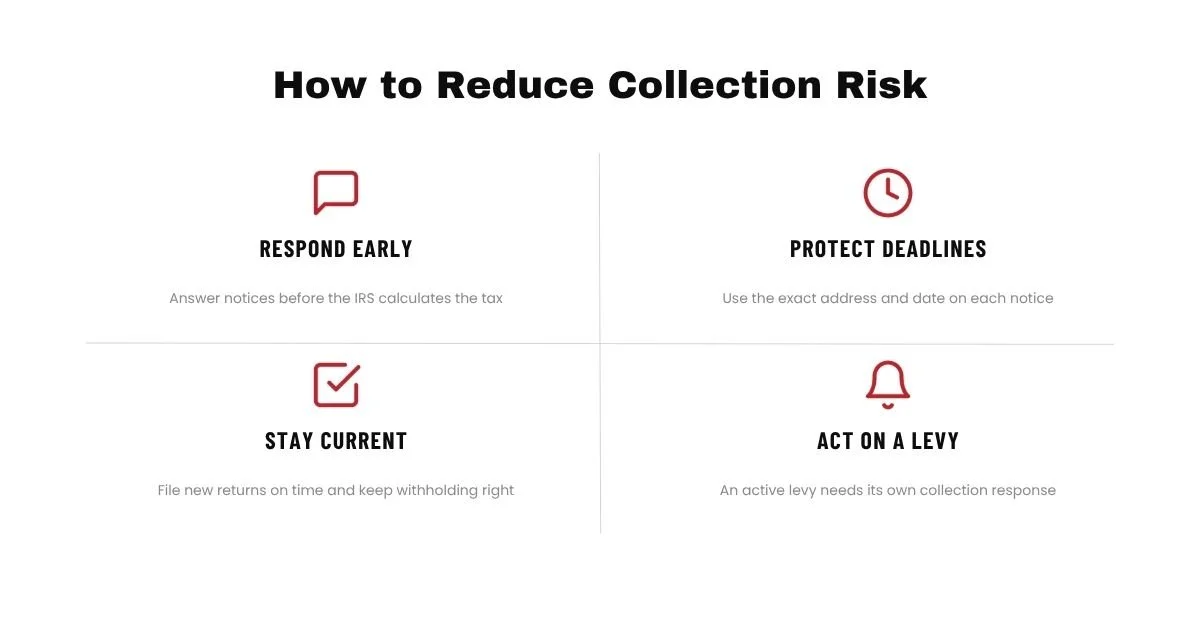
How to Reduce Collection Risk
Unfiled returns and IRS collection are connected, but they are not the same stage of the case.
The IRS generally needs an assessed balance before it can collect that balance. The assessment may come from a filed return, an audit, or a substitute for return process.
Respond Before the IRS Calculates the Tax
Responding during the return delinquency notice stage gives you more control over the figures used to determine the tax.
Once the IRS prepares and assesses a substitute return, correcting the balance may require additional review and longer processing.
Protect Every Notice Deadline
A notice may include a response deadline, a filing request, or a statutory Tax Court petition period.
Sending documents to the wrong IRS office does not necessarily protect the deadline. Use the address, fax number, response form, or electronic option stated on the notice.
File Current Returns on Time
Resolving old tax debt requires current compliance.
Continue filing all new returns and pay current withholding or estimated taxes as required. A new unfiled return or new unpaid balance can prevent approval of a payment option or cause an existing agreement to default.
Do Not Ignore an Active Levy
If the IRS has already issued a wage levy, bank levy, or final collection notice, filing the returns may be only one part of the response.
The case may also require a levy release request, financial disclosure, collection appeal, payment arrangement, or hardship review. The correct response depends on the exact notice and collection stage.

Common Mistakes When Filing Old Tax Returns
Most errors occur because the taxpayer rushes to file before the account and records have been reviewed.
Assuming the IRS Only Wants Six Years
The six year rule is an enforcement policy, not an automatic cancellation of every older filing requirement.
Review the IRS account, return type, notices, refund years, and later year calculations before deciding which returns to file.
Using Only Wage and Income Transcripts
A wage and income transcript may identify income reported to the IRS, but it may not show every item needed to prepare the return.
It may not provide complete state information, basis, business expenses, dependent information, or records needed to support deductions and credits.
Filing the Most Recent Return First
A newer return may depend on figures from an older year.
Capital loss carryovers, net operating losses, depreciation, passive losses, basis, and credit carryovers can affect several later returns.
Ignoring the Notice Response Address
A past due return sent to the normal filing center may not reach the IRS employee or unit handling an active notice.
When a notice provides filing instructions, follow those instructions and include any required response form.
Waiting Until You Can Pay in Full
Waiting to file because payment is not available can allow the failure to file penalty and other risks to continue.
File first. Then review payment plans, hardship status, penalty relief, or settlement options based on the actual assessed balance.
Assuming the Substitute for Return Is Final
An IRS prepared return may often be corrected by filing an accurate taxpayer return.
The procedure and processing time depend on whether the proposed assessment is still pending or has already been assessed.
Frequently Asked Questions About Unfiled Tax Returns
-
Yes. The IRS states that a taxpayer who has not filed a past due return can file a return for any prior year.
The two most recent prior years may be eligible for electronic filing through a provider that offers prior year e filing. Older returns are generally submitted on paper or according to the instructions for an active IRS notice.
Use the correct forms and tax rules for each year. Keep a signed copy and proof that the IRS received the return.
-
If you were required to file, the IRS may send return delinquency notices, hold refunds, assess penalties, prepare a substitute for return, and eventually begin collection if an assessed balance remains unpaid.
The normal assessment period does not begin when no required return was voluntarily filed. The IRS can assess tax through the substitute for return program, and an IRS prepared return does not start the normal three year assessment period.
The exact result depends on whether a return was required, whether tax is due, and how far the case has progressed.
-
Yes. The IRS may calculate tax using income reported by employers, banks, brokers, payment processors, and other sources.
That calculation may omit deductions, credits, dependents, business expenses, and favorable filing status information. You may still be able to file an accurate return and request that the IRS adjust the assessment.
A CP3219N notice includes a limited Tax Court petition period. Filing a return does not extend that statutory deadline.
-
Possibly, but the refund claim deadline is critical.
A taxpayer generally must file within three years of the return due date to claim withholding, estimated payments, or refundable credits. Other refund limitation rules may affect the amount available.
When the applicable refund statute has expired, the IRS generally cannot issue the refund or move the overpayment to another year.
-
An unfiled return does not usually create an immediate wage levy by itself.
The IRS must first establish an assessed tax balance. That can happen after you file a balance due return or after the IRS completes a substitute for return assessment. If the balance remains unpaid and the IRS completes the required collection notice process, it may levy wages or other property.
Filing the missing returns is often necessary, but an active wage levy may require a separate collection response.
-
Yes, many taxpayers can request an installment agreement after filing the required returns.
The IRS states that most payment plans and relief options require all required returns to be filed. Online eligibility depends on the balance, taxpayer type, and the requested payment term.
Interest and applicable penalties generally continue until the debt is fully paid or otherwise resolved.
-
Most unfiled return matters begin and remain civil compliance cases involving returns, penalties, assessments, and collection.
However, the IRS states that repeated failure to file can result in additional enforcement, including possible criminal prosecution. Criminal tax cases generally require evidence of willful conduct, meaning deliberate action with the intent to violate the law. Being late, disorganized, or unable to pay does not automatically establish criminal willfulness.
Anyone concerned about possible criminal exposure should obtain legal advice before giving statements or records to an investigating agent.
-
Not every missing return requires representation. A taxpayer with one simple late return, complete records, no IRS notices, and no substantial balance may be able to prepare and file it using the correct prior year forms.
Professional help becomes more important when several years are missing, the records are incomplete, business income is involved, the IRS filed a substitute return, a CP3219N deadline is open, collection action has begun, or the taxpayer needs tax debt help after filing.
A credentialed representative can also review transcripts, communicate with the IRS under a valid power of attorney, and confirm that each return is processed correctly.
Bottom Line
Unfiled tax returns are usually easier to correct before the IRS prepares its own assessment or begins collection.
The process starts by confirming which returns are missing and whether each return was required. Next, obtain IRS transcripts, reconstruct the records, prepare accurate returns, protect any refund or notice deadlines, and file each return in the proper place.
Do not wait until you can pay the full amount. Filing and payment are separate obligations. Once the returns are processed, review the actual tax debt and determine whether full payment, an installment agreement, temporary hardship status, penalty relief, or an offer in compromise is appropriate.
My approach is clarity first, then the numbers. The correct solution begins with an accurate account history and complete returns. It does not begin with guessing how much the IRS may accept or assuming that an old year no longer matters.