
Can the IRS Settle Your Tax Debt for Less? What You Need to Know about Tax Settlements
Can the IRS really settle your tax debt for less than you owe?
Yes, it can happen, but not the way most ads make it sound.
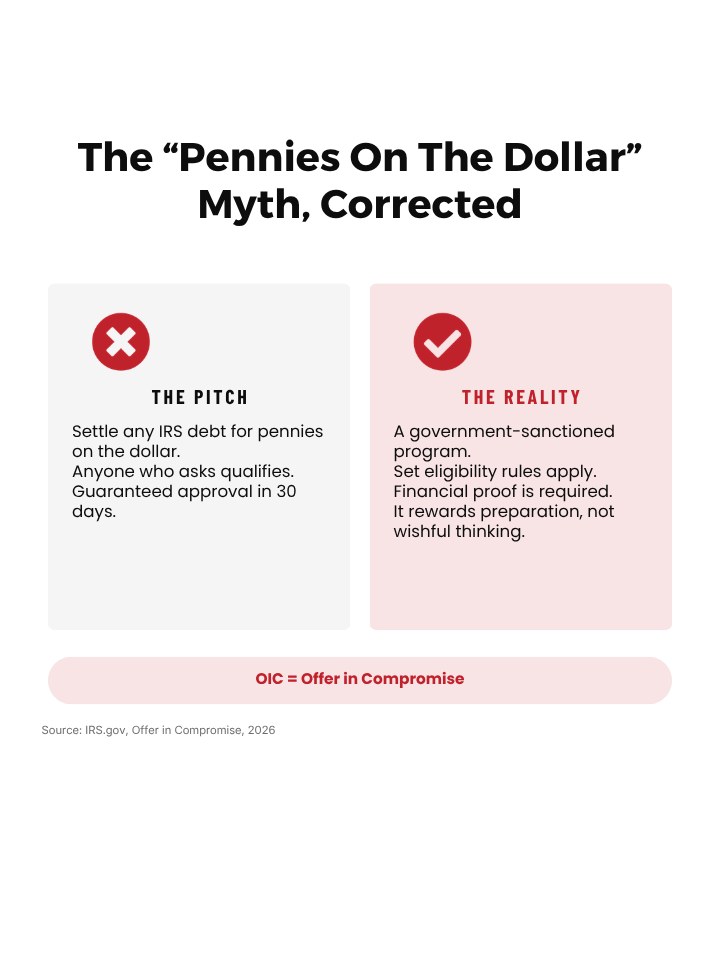
You may have heard companies promise that taxpayers can settle IRS debt for “pennies on the dollar.” That kind of language makes the program sound either too good to be true or only available to people in extreme financial hardship.
The truth is more practical.
The IRS does accept less than the full balance from taxpayers who qualify. The program is called an Offer in Compromise, and it is an official IRS resolution option. But it is not automatic. The IRS reviews your income, expenses, assets, filing history, and ability to pay before deciding whether a settlement makes sense.
In other words, the IRS is not asking what you want to pay. It is calculating what it believes it can realistically collect from you.
At Semper Tax Relief, our credentialed team has helped clients through accepted Offer in Compromise cases where significant IRS balances were resolved for a fraction of what was owed. Those outcomes were not based on luck or guesswork. They came from accurate financial documentation, properly prepared forms, and a clear understanding of how the IRS evaluates collection potential.
This article walks you through that framework so you can better understand how IRS tax debt settlements work, who may qualify, and what to review before taking the next step.

IRS tax Debt Settlements Summary TLDR;
Yes, the IRS can settle tax debt for less through an Offer in Compromise.
An OIC is a real IRS program, not a loophole or automatic forgiveness.
The IRS only accepts less when the taxpayer’s financial numbers show the full balance is not realistically collectible.
Most accepted OICs are based on doubt as to collectibility.
Taxpayers must file all required returns and stay current on tax payments before the IRS will review an offer.
The IRS calculates eligibility using Reasonable Collection Potential, which includes asset equity and future disposable income.
Form 656 and Form 433-A OIC or Form 433-B OIC are required for most offers.
OIC applications require supporting documents, an application fee, and an initial payment unless the taxpayer qualifies for low-income certification.
The OIC process can take several months and may run up to 24 months.
Offers are often rejected when the offer amount is below the IRS calculated collection potential or the taxpayer is not compliant.
If an OIC does not fit, payment plans, Currently Not Collectible status, or penalty abatement may be better options.
A successful OIC depends on accurate financial disclosure, complete documentation, and realistic eligibility.
Can the IRS Really Settle My Tax Debt for Less? Here's What You Need to Know
The Offer in Compromise program exists because the IRS made a practical decision: collecting something is better than collecting nothing from a taxpayer who genuinely cannot pay. Congress codified this logic into law, and the IRS administers it through a formal application process. This is not a loophole or a gray area, it is a defined resolution pathway with published rules, required forms, and documented outcomes.
How the Offer in Compromise program works
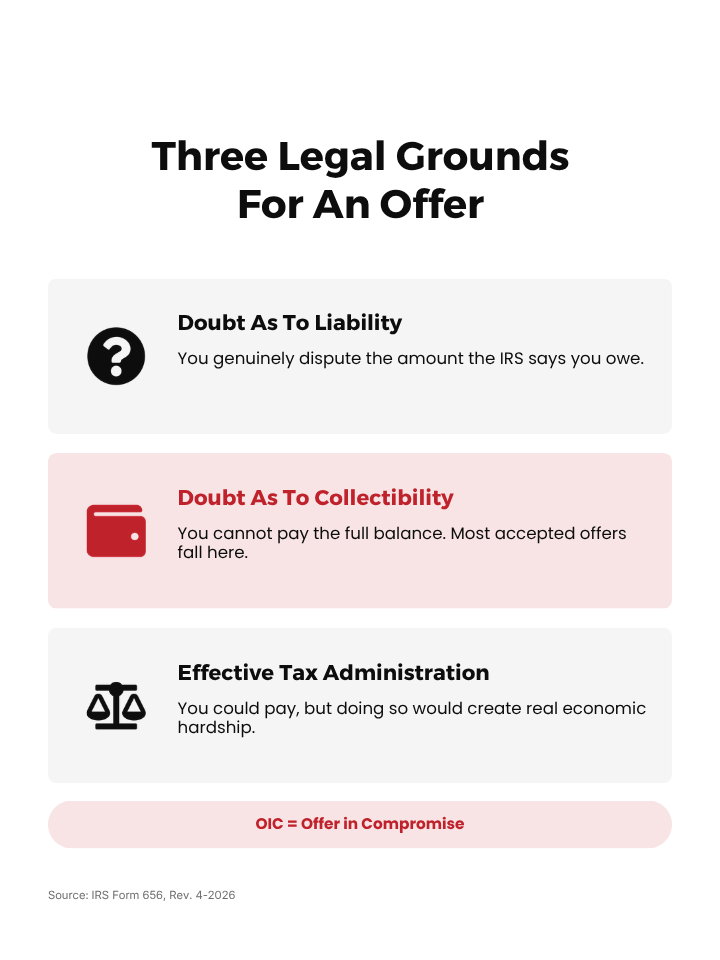
An OIC can be submitted on three legal grounds: Doubt as to Liability (you genuinely dispute the amount owed), Doubt as to Collectability (you cannot pay the full balance), or Effective Tax Administration (paying in full would create an economic hardship that undermines basic equity). The overwhelming majority of accepted offers fall under Doubt as to Collectability. In plain terms, the IRS runs the numbers, determines that it cannot collect the full balance before its collection window closes, and agrees to settle for the amount it can realistically recover.
If you want a deeper breakdown of the IRS Offer in Compromise process, review the full program guide before submitting anything to the IRS.
Acceptance rates tell the real story
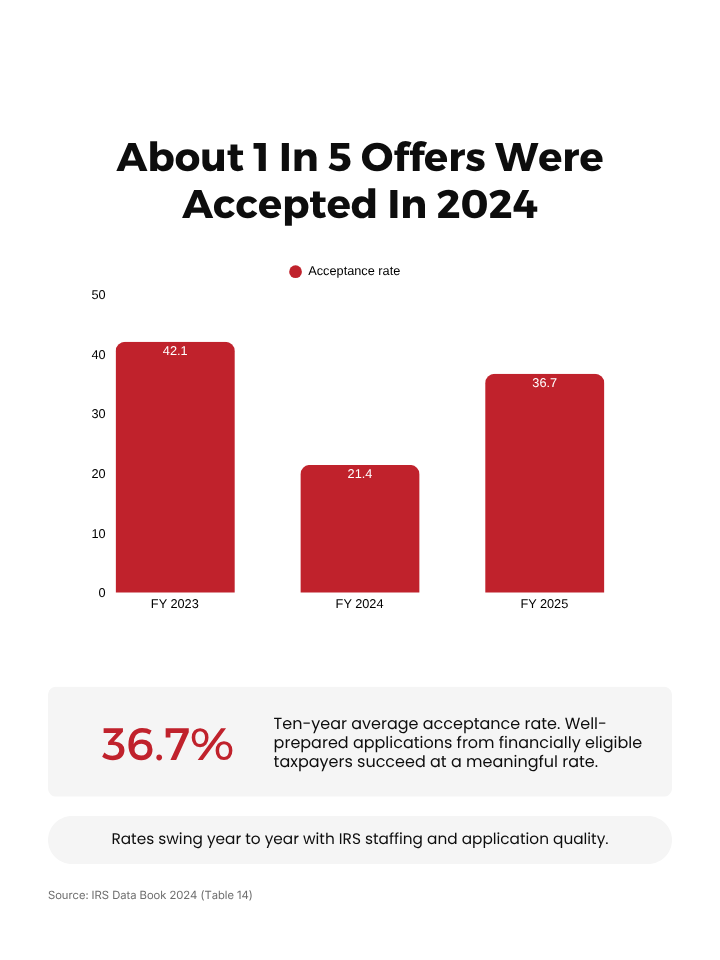
OIC acceptance is neither automatic nor impossible. The IRS accepted approximately 36% of submitted offers in 2022 and roughly 40% to 42% in 2023. The ten-year average hovers around 37%. These numbers confirm that properly prepared applications from financially eligible taxpayers succeed at a meaningful rate. The program is not a rubber stamp, but it is also not a long shot for the right candidate. For a plain language overview of how the program works and what to expect, see TurboTax's Offer in Compromise overview.
Who Qualifies to Settle Tax Debt for Less: The Real Eligibility Criteria
The most persistent myth about the OIC program is that anyone who asks can get a settlement. The IRS applies specific prerequisites before it even opens a financial review. Understanding these requirements upfront saves you the application fee, the non-refundable initial payment, and weeks of wasted effort.
The non-negotiable prerequisites
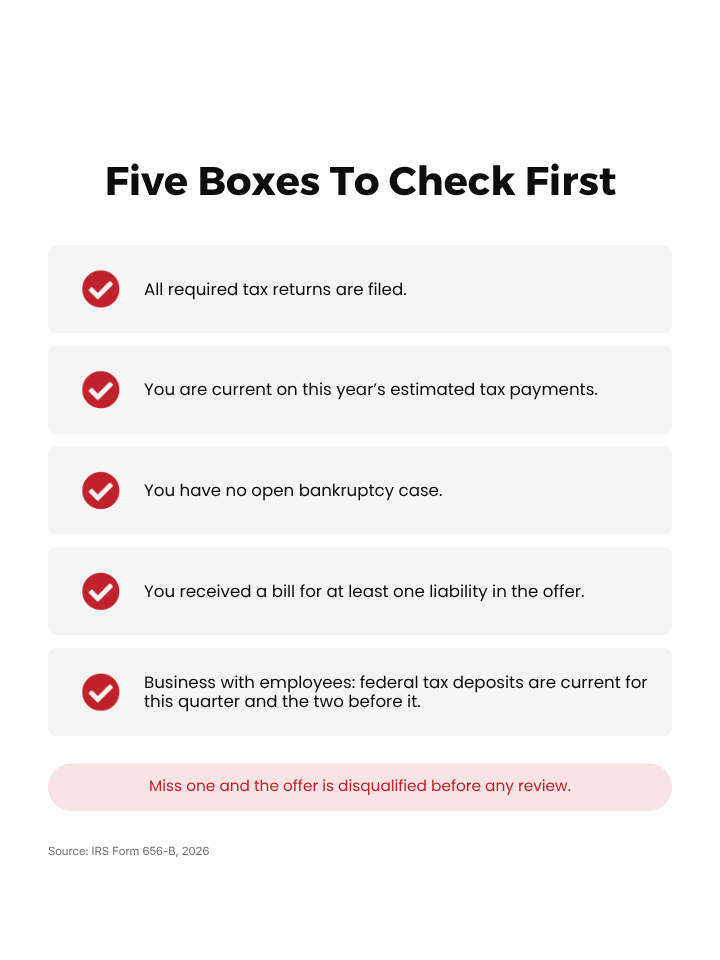
Before the IRS reviews the substance of your offer, your account must meet a checklist of basic conditions. You must have filed all required tax returns, be current on any estimated tax payments due for the present year, have no open bankruptcy proceeding, and have received a bill for at least one tax liability included in the offer. Business owners with employees face an additional requirement: federal tax deposits must be current for the present quarter and the two preceding quarters. Failing any one of these conditions results in automatic disqualification, regardless of how compelling your financial hardship may be.
What "can't pay" actually means to the IRS
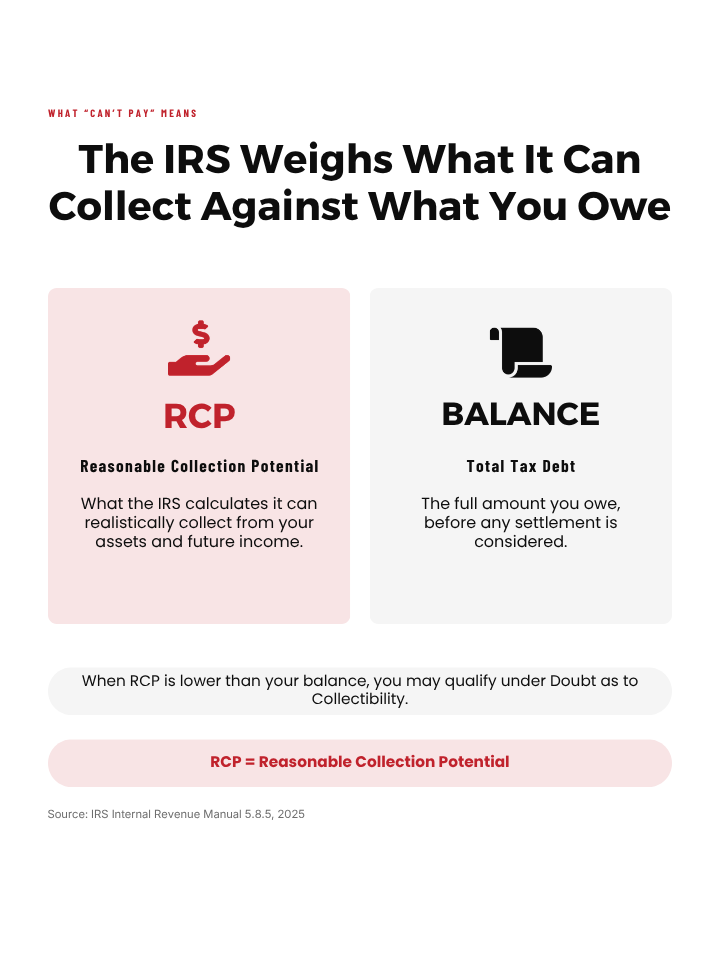
The IRS does not define financial hardship loosely. To qualify under Doubt as to Collectability, your Reasonable Collection Potential (RCP) must be lower than your total tax balance. RCP is a calculated figure based on your assets and future income, not simply a statement that you feel financially stressed. This distinction matters enormously. A taxpayer with a paid-off home, a retirement account, and steady income may have a higher RCP than they realize, which is exactly why professional review matters before submitting anything.
The IRS OIC Pre-Qualifier tool
The IRS offers a free online Pre-Qualifier tool that walks you through a basic eligibility assessment. It provides a rough estimate of whether you might qualify and what offer amount the IRS would likely require. Think of it as a starting point, not a final answer. The actual review examines your finances in detail, and professional preparation of your financial statements can make a significant difference in how your RCP is calculated.
How the IRS Calculates What You Must Offer
This is where most online articles fall short. Understanding the RCP formula is the single most important factor in determining whether you have a viable OIC case. (You can also test scenarios using our IRS OIC Calculator.) It also reveals why two taxpayers with the same tax balance can have very different settlement outcomes.
Before making an offer, review the IRS Offer In Compromise Calculation so you understand how asset equity and monthly disposable income affect the settlement amount.
The Reasonable Collection Potential formula
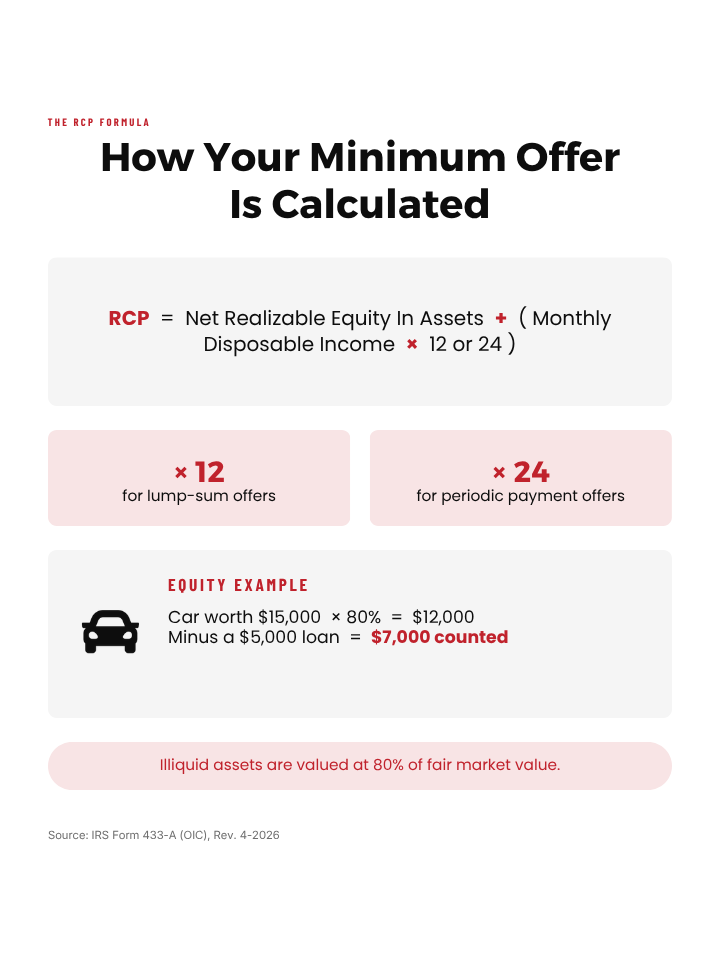
RCP equals your net realizable equity in assets plus a multiplier applied to your monthly disposable income. For lump-sum offers, the IRS multiplies monthly disposable income by 12; for periodic payment offers, it uses 24. Net realizable equity is calculated by taking the fair market value of an asset, applying an 80% discount (for illiquid assets like real estate, vehicles, and retirement accounts), and subtracting any outstanding loan balance. A car worth $15,000 with a $5,000 loan, for example, contributes $7,000 to your RCP ($15,000 × 80% = $12,000, minus $5,000). Take a taxpayer who owes $90,000, has limited home equity, one vehicle with a loan, and $200 per month in disposable income after allowable expenses. Their RCP might calculate to $9,200 ($200 × 12 = $2,400 in income component, plus $6,800 in net asset equity). An offer submitted at $9,500, slightly above RCP, gives the IRS reason to accept. The debt doesn't vanish; it resolves at the amount the IRS calculates it can realistically recover. For taxpayers in this position, the ability to settle tax debt for less can mean the difference between financial recovery and years of wage garnishments.
What documentation you need to submit
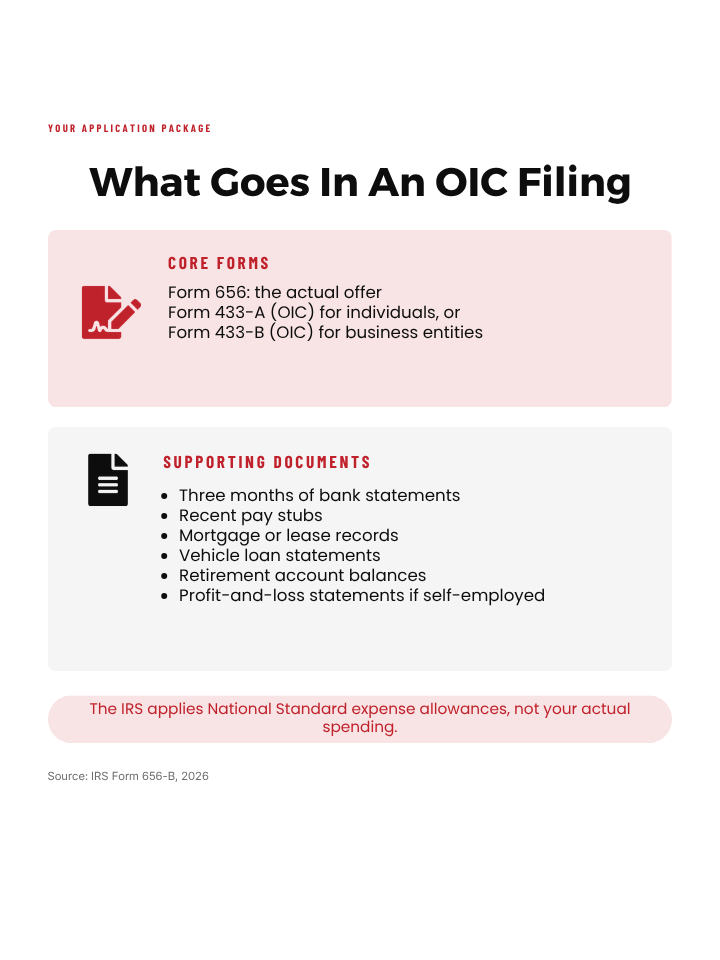
The application package centers on Form 656 (the actual offer) and either Form 433-A (OIC) for individuals or Form 433-B (OIC) for business entities. Supporting documentation includes three months of bank statements, recent pay stubs, mortgage or lease records, vehicle loan statements, retirement account balances, and profit-and-loss statements for self-employed filers. One critical detail: the IRS applies National Standard expense allowances based on household size and Bureau of Labor Statistics data, not your actual monthly spending. If your real expenses exceed those standards, the IRS uses the lower standard figure in its calculation, which is why working with a professional who understands how to properly document legitimate expense deviations is so valuable.
Gather your tax relief supporting documents before applying because the IRS reviews proof, not estimates.
The $205 application fee and initial payment requirement
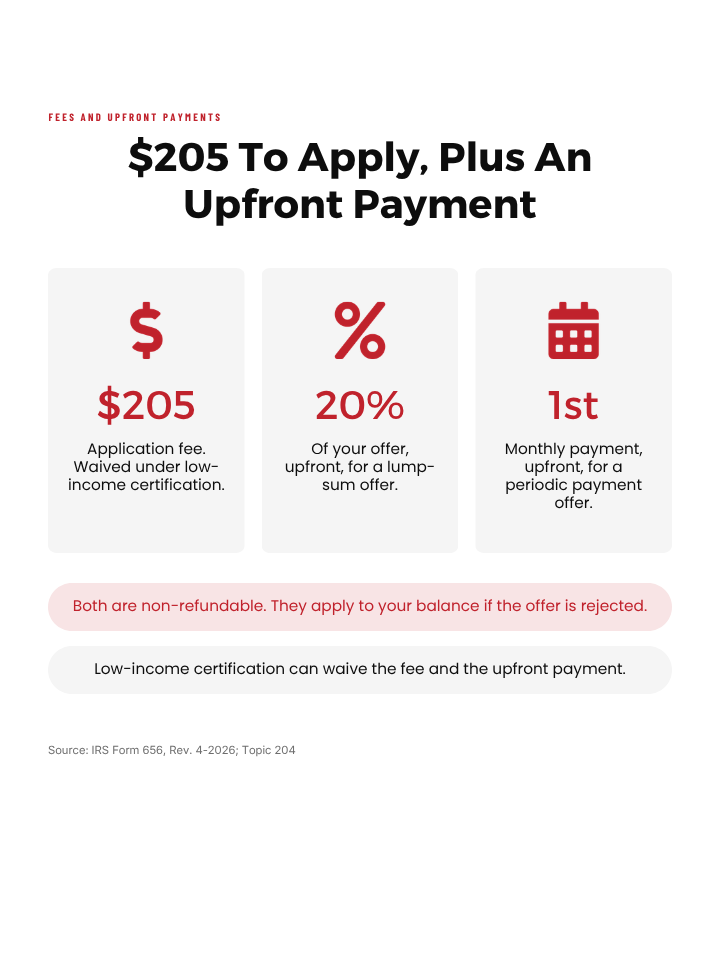
Every OIC application requires a non-refundable $205 application fee, waived for taxpayers who qualify under the low-income certification. You must also submit either 20% of the offer amount upfront (for lump-sum offers) or the first monthly payment (for periodic payment plans). These payments are non refundable even if the IRS ultimately rejects your offer. That reality underscores why submitting a properly prepared, complete application is worth every bit of effort before filing.
What to expect: timelines, rejection reasons, and real outcomes
Setting accurate expectations protects you from abandoning a legitimate IRS tax debt relief strategy, and from trusting anyone who promises approval in 30 days.
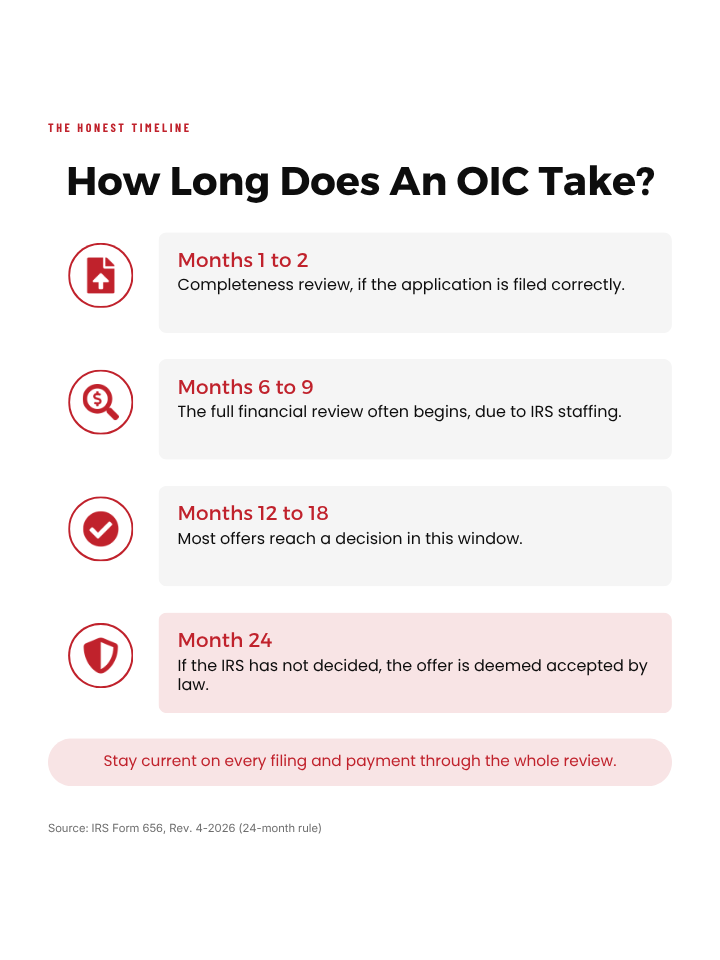
The honest timeline: 7 to 24 months
The initial completeness review takes one to two months if your application is properly submitted. After that, the full financial review often doesn't begin for six to nine months due to IRS staffing constraints. End-to-end, most OICs take 12 to 18 months to resolve. There is a built-in protection: if the IRS does not issue a decision within 24 months of receiving your application, the offer is legally deemed accepted. That protection requires you to remain fully compliant throughout the review period, meaning all filings and payments must stay current. For additional detail on taxpayer rights and timing, see the Taxpayer Advocate Service notices on Offer in Compromise.
Why most OICs get rejected or returned
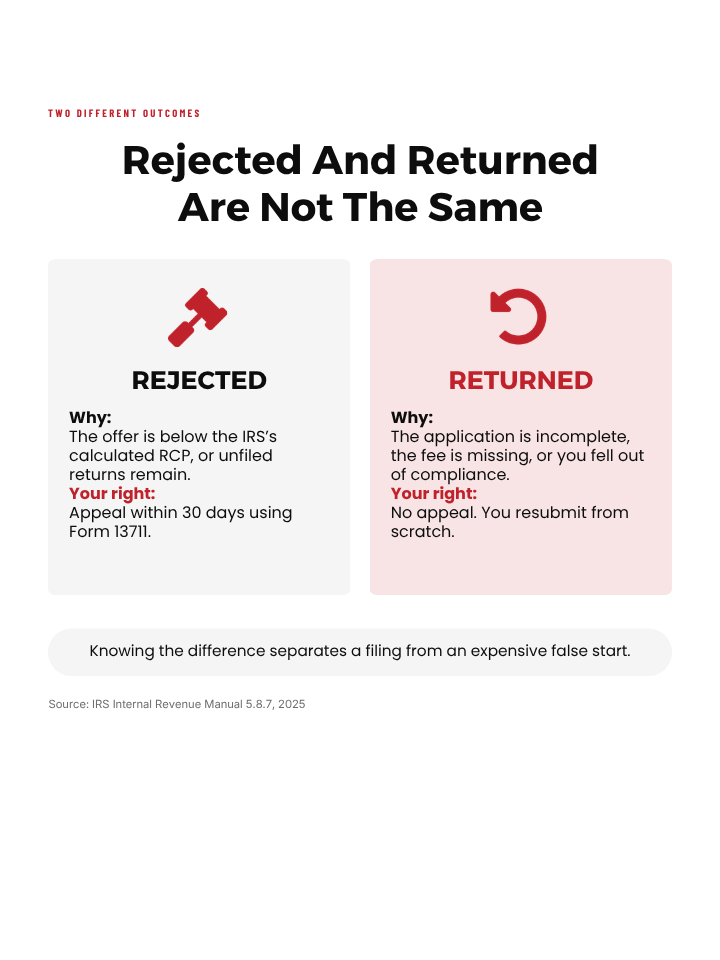
Rejections most commonly happen because the submitted offer amount is lower than the IRS's calculated RCP, or because unfiled returns still exist at the time of submission. Returned applications, which carry no right to appeal, occur when the application is incomplete, the fee is missing, or the taxpayer falls out of compliance during the review. A rejected offer can be appealed within 30 days using Form 13711. A returned application requires resubmission from scratch. Knowing these distinctions in advance separates a successful filing from an expensive false start.
Real-world settlement outcomes: what the numbers look like
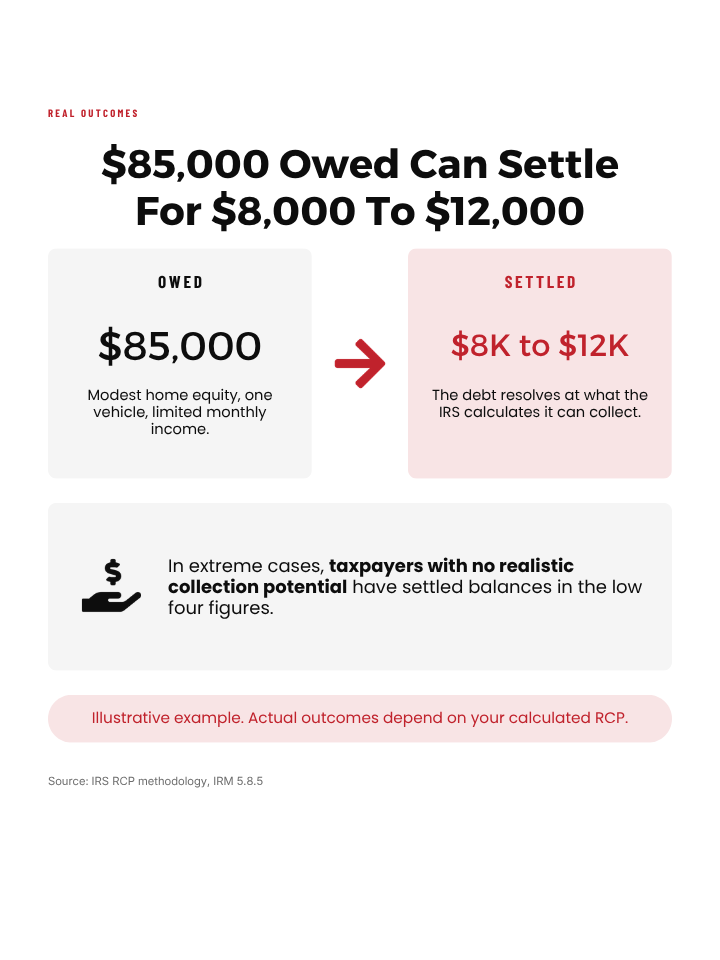
A taxpayer with $85,000 in IRS debt, modest home equity, one vehicle, and limited monthly income might settle for $8,000 to $12,000 depending on their calculated RCP. In more extreme cases, taxpayers with no realistic collection potential have settled balances in the low four figures. Semper Tax Relief has verified OIC acceptance results on file where clients with substantial balances resolved their cases for a fraction of what was owed through accurate documentation and credentialed representation. These outcomes are not exceptional, they reflect what the program is designed to produce when applied correctly.
When an OIC isn't the right fit: Other Resolution Paths Worth Knowing
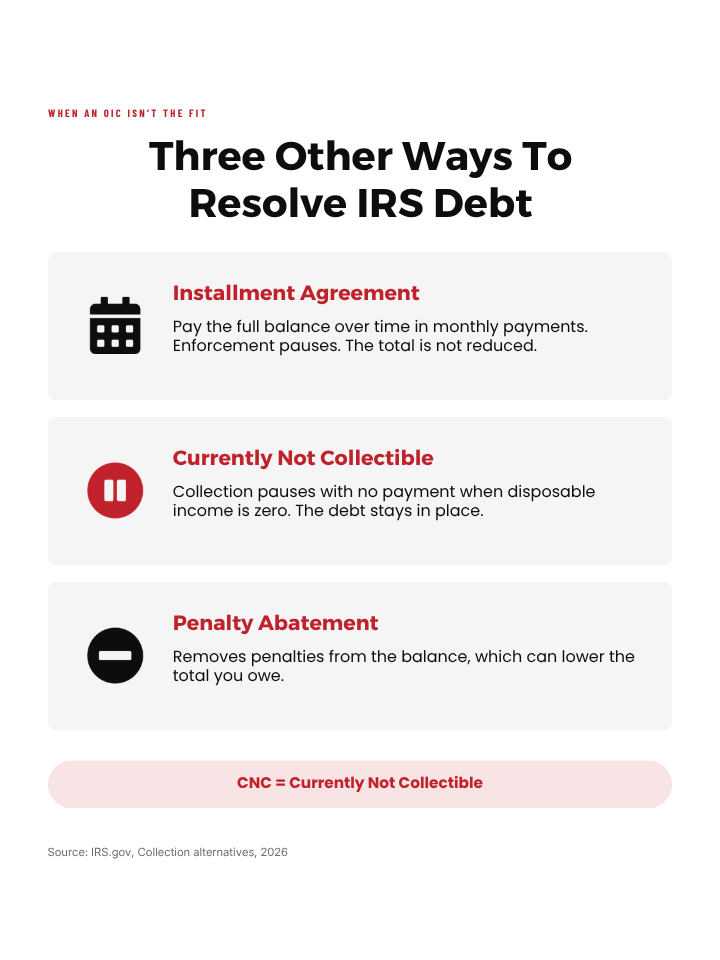
Not every taxpayer qualifies for an OIC, and for some, a different resolution path is actually the better option. For some taxpayers, one of these alternatives produces a faster or lower-cost resolution than an OIC would.
IRS installment agreement
An installment agreement allows you to pay the full balance over time in monthly installments while the IRS suspends enforcement actions like wage garnishments and bank levies. This path fits taxpayers with steady income who can pay the full balance within six years but cannot do so immediately. For debts under $100,000, the IRS generally accepts the lowest monthly payment that clears the liability within the required timeframe. It doesn't reduce the total owed, but it creates a structured, enforceable path to compliance.
If the IRS believes you can pay the balance over time, IRS payment plans may be more realistic than an OIC.
Currently Not Collectible (CNC) status
CNC status pauses all IRS collection activity with no payment required, available when your monthly disposable income after essential living expenses is zero. It typically lasts six to twelve months before the IRS reassesses your financial situation. A federal tax lien may still be filed during this period, and the underlying debt remains, enforcement simply stops. For taxpayers in acute financial crisis who need immediate relief while they stabilize, CNC status buys meaningful time without requiring an OIC-level application.
If you have no disposable income after necessary living expenses, IRS Currently Not Collectible status may pause collection without requiring an immediate payment.
Penalty abatement as a cost-reducer
Penalty abatement removes accumulated penalties from your balance, which can reduce the total owed significantly without requiring you to prove the level of financial hardship that an OIC demands. It's particularly effective when paired with an installment agreement to lower monthly payments, or when the taxpayer has a clean prior compliance history and a documented reasonable cause for the original failure to file or pay. It doesn't eliminate the underlying tax, but it can make the overall resolution considerably more manageable.
If penalties make up a large part of your balance, IRS penalty forgiveness may reduce the amount owed through first-time abatement or reasonable cause relief.
How to apply safely and find the right help
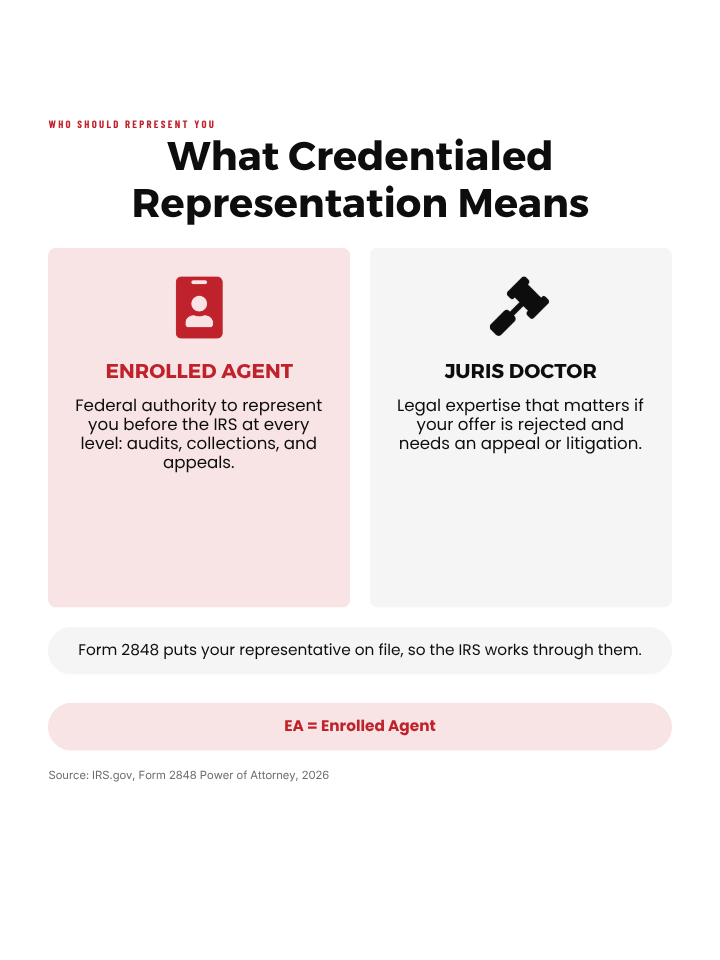
The OIC application process is not something to navigate alone, especially with non-refundable fees and a rejection risk that resets your timeline. Knowing what credentialed representation actually looks like protects you from both costly mistakes and predatory firms. For step-by-step instructions, see our How to make the offer for the IRS Offer in Compromise.
Red flags of predatory tax settlement companies
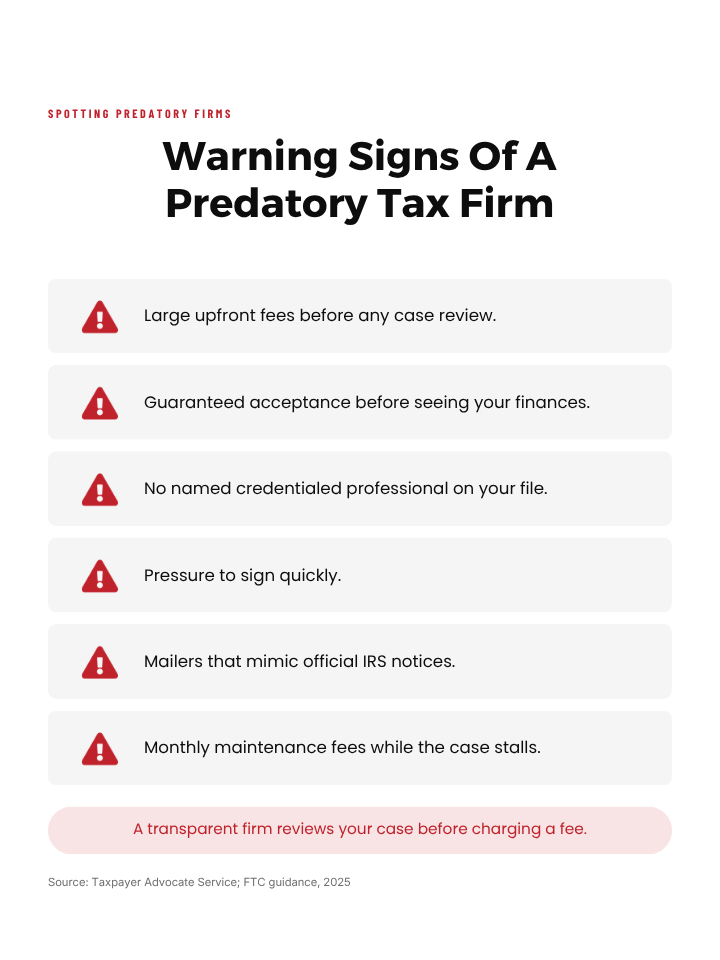
Legitimate warning signs include: large upfront fees before any case review, guarantees of acceptance before examining your finances, no named credentialed professional assigned to your file, and pressure to sign quickly. Some firms advertise using language that mimics official IRS notices, and others charge monthly maintenance fees while intentionally stalling the process. Any firm that promises a specific outcome before reviewing your income, assets, and compliance history is operating outside the bounds of honest practice. Semper Tax Relief offers a free case review valued at $595 before any fee is charged, because a transparent firm builds its reputation on actual case outcomes, not on what it can collect before the work begins.
Your next step if you think you qualify
Start with the IRS Pre-Qualifier tool for a rough self-assessment, then consult with a credentialed tax professional before submitting anything. An improperly filed OIC costs you the $205 application fee, your non-refundable initial payment, and potentially damages your standing with the IRS during an active review period. Getting it right the first time isn't just about efficiency, it's about protecting your one realistic opportunity to resolve the debt on favorable terms. For more background, read our The Ultimate IRS Offer In Compromise Guide. The right representation gives your offer the strongest possible foundation before the IRS ever opens the file.
Can the IRS Settle Your Tax Debt for Less? What Taxpayers Need to Know FAQs
-
Yes. The IRS can settle tax debt for less than the full amount owed through an Offer in Compromise. This does not happen automatically, and it is not based on the size of the balance alone. The IRS reviews your income, expenses, assets, filing compliance, and Reasonable Collection Potential to decide whether the full debt can realistically be collected.
-
A taxpayer may qualify for an Offer in Compromise when they cannot pay the full IRS balance based on their financial situation. Before the IRS reviews the offer, all required tax returns must be filed, current estimated tax payments must be addressed, and there cannot be an open bankruptcy case. Business owners with employees must also be current on required payroll tax deposits.
-
The IRS calculates your offer using Reasonable Collection Potential, often called RCP. This includes your net equity in assets plus your future disposable income. For a lump-sum offer, the IRS generally multiplies monthly disposable income by 12. For a periodic payment offer, it generally uses 24 months. Your offer usually needs to meet or exceed that calculated amount.
-
If the IRS rejects your Offer in Compromise, it should send a written explanation. A rejection often happens when the IRS believes your Reasonable Collection Potential is higher than the amount offered. You may have 30 days to appeal using Form 13711. If the issue can be corrected with better documentation, updated asset values, or revised income and expense figures, an appeal may be worth reviewing.
-
If you do not qualify for an Offer in Compromise, you may still have other IRS resolution options. An installment agreement may allow you to pay the balance over time. Currently Not Collectible status may pause collection if you cannot afford payments. Penalty abatement may reduce part of the balance if you qualify. The right option depends on your income, assets, expenses, tax compliance, and collection risk.
The bottom line: Can the IRS really settle my tax debt for less?
Yes, the IRS can and does settle tax debt for less than what's owed. The OIC program is real, government-sanctioned, and has produced accepted IRS tax debt relief settlements for tens of thousands of taxpayers every year. But it is not a blanket amnesty program, and it is not available simply because someone applies. It works when a taxpayer's financial situation genuinely supports it under the RCP formula, when all eligibility prerequisites are met, and when the application is complete, accurate, and submitted with proper documentation.
The path from a large IRS balance to an accepted settlement requires honest financial disclosure, correct form preparation, and consistent compliance throughout the review period. Shortcuts at any stage create problems that are expensive to fix. If you're wondering whether you can settle your tax debt for less, the most productive first step is a real case review with a credentialed professional, not a late-night commercial or an online form that generates a callback from an anonymous rep.
Semper Tax Relief offers that review at no cost. A single consultation with a credentialed Enrolled Agent and J.D. will give you a clearer picture of your options than any amount of general research. Reach out to schedule your free strategy session and get a clear, honest assessment of whether an Offer in Compromise, an installment agreement, or another resolution path is the right fit for your situation. Check your eligibility now with the IRS Pre-Qualifier or schedule your free review with Semper Tax Relief today.