
IRS Form 8821 (Tax Information Authorization), How It Gives Limited Authority Without Full Power of Attorney
TLDR;
Form 8821 = “view-only” access. It is a Tax Information Authorization, not an IRS power of attorney.
No representation power. Form 8821 does not let anyone speak, negotiate, or sign for you with the IRS. That requires Form 2848.
8821 vs 2848:
8821 → share information/transcripts.
2848 → full IRS representation within listed years/issues.
Best use of 8821: diagnostic work – pulling transcripts, checking balances, confirming missing returns, and supporting loan/underwriting requests.
Good first step with a tax relief firm: use 8821 to review your IRS account before you commit to full representation.
Scope matters. Line 3 should list specific forms and years; avoid vague “all years/all taxes.”
Security & ethics: the form is limited, but you should still vet the company; aggressive firms can misuse access to pressure you.
You stay in control. 8821 can be revoked or replaced at any time with a new form or a written revocation.
Common mistakes:
Overly broad years/tax types
Thinking 8821 = power of attorney
Not checking the box to send your designee copies of notices when you actually want that
Smart workflow: start with 8821 for facts and planning, then move to 2848 only if and when you’re ready for true IRS representation.
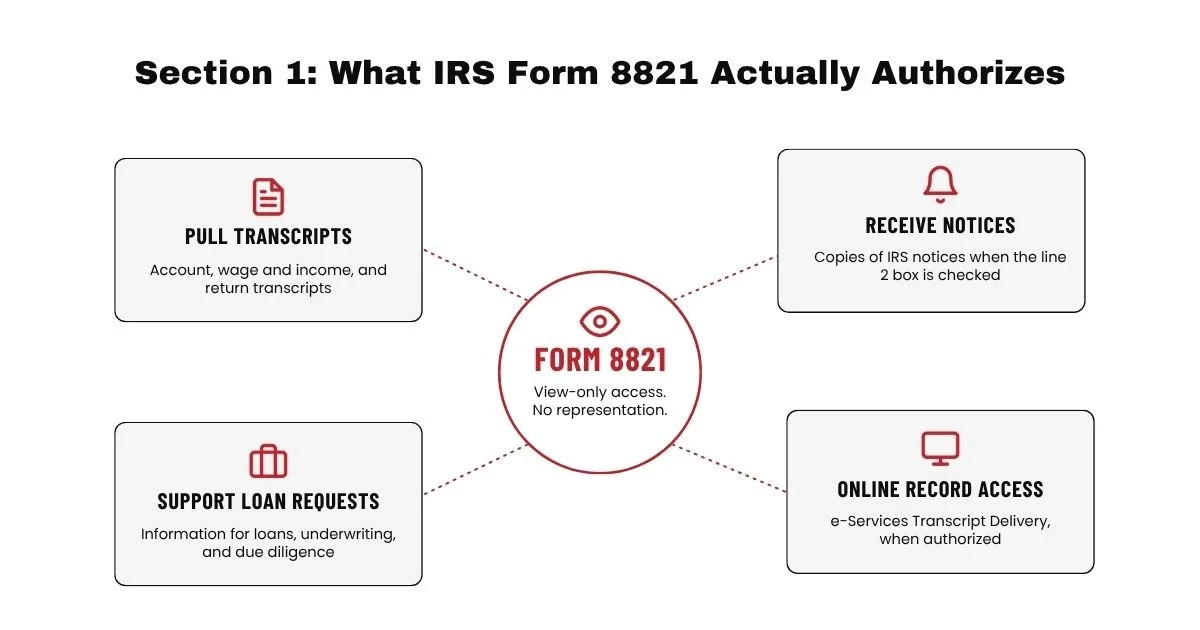
Section 1: What IRS Form 8821 Actually Authorizes
According to the IRS, you file Form 8821 to
Authorize any individual, corporation, firm, organization, or partnership you choose to inspect and or receive your confidential tax information, verbally or in writing, for specific tax matters and years you list
Delete or revoke prior tax information authorizations on file
From the official Instructions for Form 8821, in plain language
Form 8821 authorizes the person or company you list to see your tax information. It does not authorize them to
Speak on your behalf
Advocate your position
Execute waivers, consents, or closing agreements
Represent you in any manner before the IRS
What your designee can do with Form 8821
With a properly completed and filed IRS Form 8821, your designee can
Pull IRS account transcripts, wage and income transcripts, and return transcripts
Receive copies of certain IRS notices, if you check the box on line 2
Request information needed for loans, underwriting, due diligence, or tax relief analysis
Access online IRS records through e Services Transcript Delivery, if you authorize that
What Form 8821 does not authorize
The IRS is very clear that Form 8821 is not an IRS power of attorney.
With only Form 8821 in place, your designee cannot
Represent you at an audit or appeal
Negotiate an installment agreement, Offer in Compromise, or other settlement
Argue your position about tax law or account adjustments
Sign waivers, consents, or closing agreements
Endorse or negotiate your refund check or receive your refund by direct deposit
For those activities, you need IRS Form 2848 and a qualified representative, such as an Enrolled Agent, CPA, or attorney.

Section 2, IRS Form 8821 vs Form 2848, Limited Authority vs Full Representation
This is where most taxpayers get confused, Form 8821 compared to Form 2848.
High level comparison
Type of authorization
Form 8821, Tax Information Authorization
Form 2848, Power of Attorney
What it does
Form 8821, lets your designee see and receive confidential tax information for specific tax matters and years
Form 2848, lets your representative both see your information and represent you before the IRS
IRS representation
Form 8821, no representation, they cannot advocate, negotiate, or argue your case
Form 2848, full representation within the scope you list, such as audits, appeals, and collections
Who you can appoint
Form 8821, anyone you choose, a tax pro, lender, lawyer, bookkeeper, even a non professional
Form 2848, someone who is eligible to practice before the IRS, such as an EA, CPA, attorney, or other limited categories like certain family members in specific situations
Typical use cases
Form 8821 is commonly used when you
Want a tax professional, lender, or advisor to review your IRS account and transcripts before you fully engage
Need income verification for loans or student aid
Want an internal review of your IRS history before strategy is decided
Form 2848 is commonly used when
You have active IRS problems
You are facing audits, tax debt collections, Appeals, Offers in Compromise, or complex issues that need someone to speak and negotiate for you
Level of authority
Form 8821, limited authority, think read only access
Form 2848, broad authority within the tax years and issues listed, think authorized agent
Signing agreements
Form 8821, cannot sign IRS agreements
Form 2848, can sign certain agreements, consents, and extension requests within the scope of authority
CAF recording
CAF is the IRS Centralized Authorization File.
Form 8821, generally recorded on CAF unless you check the specific use only box
Form 2848, also recorded on CAF
Revoking prior authorizations
A new Form 8821 can revoke previous 8821 authorizations for the same matters and years, unless you attach the ones you want to keep
A new Form 2848 can revoke prior 2848 authorizations for the same matters and years, unless you specify otherwise
Bottom line
Form 8821, IRS taxpayer authorization to share information
Form 2848, IRS representation authorization

Section 3: How I Decide When To Use IRS Form 8821 vs Form 2848
In my tax relief practice, I use a simple decision framework.
Question 1, Is there already an active fight with the IRS
Do you already have an audit notice, levy, lien filing, Appeals matter, or aggressive collections
If yes, I usually go straight to Form 2848 so I can fully represent you
Question 2, Are we still in diagnostic mode
You are pretty sure you owe, but you do not know how much
You are not sure which years have balances
You do not know what the IRS has on file
Here, Form 8821 is ideal. It lets me pull transcripts, notices, and account history so I can build a game plan before stepping into full representation.
Question 3, Is a third party asking for IRS information
If a lender, SBA program, or bank needs IRS proof for underwriting or income verification, the IRS often recommends using a Tax Information Authorization such as Form 8821 or transcript request tools.
Question 4, Does the taxpayer want a soft start with a tax relief firm
Some clients are cautious, with good reason.
In those cases, we use Form 8821 first so I can review the IRS account before you commit to a full representation engagement.
After I show you exactly what the IRS records say, you can decide if you want to move forward with Form 2848.
Question 5, Is there a potential for abuse
I always review
Which years are being authorized
Which tax types are listed
Whether the firm wants copies of all notices
If I see extremely broad authorizations with no clear purpose, that is a red flag, especially with high pressure telemarketing style tax firms.

Section 4: Pros and Cons of Signing IRS Form 8821
Pros of IRS Form 8821
Form 8821 can be very useful when used correctly. It
Lets a trusted tax professional see what the IRS sees, transcripts, balances, penalties, and filing history
Does not grant IRS power of attorney, your designee cannot bind you to deals, agreements, or tax positions
Is helpful for pre engagement reviews, for example, is my case worth pursuing, what years are open, what are the statute dates
Is useful for loan applications and lender verification, many lenders and SBA programs rely on transcript based verification
Can be limited by year, tax type, and specific matters, which keeps the scope controlled
Can be revoked or replaced with a new authorization at any time
Cons and risks of Form 8821
You still need to respect the risks.
You are giving access to confidential tax records that contain sensitive data
A bad actor can use your tax information for aggressive sales pressure, even if they cannot act in front of the IRS
If you authorize too many years or all tax types, the designee may see more than is truly necessary
Some taxpayers misunderstand Form 8821 and assume, my tax relief company is already my official representative, which can cause dangerous delays when a real power of attorney Form 2848 is needed with Collections or Appeals
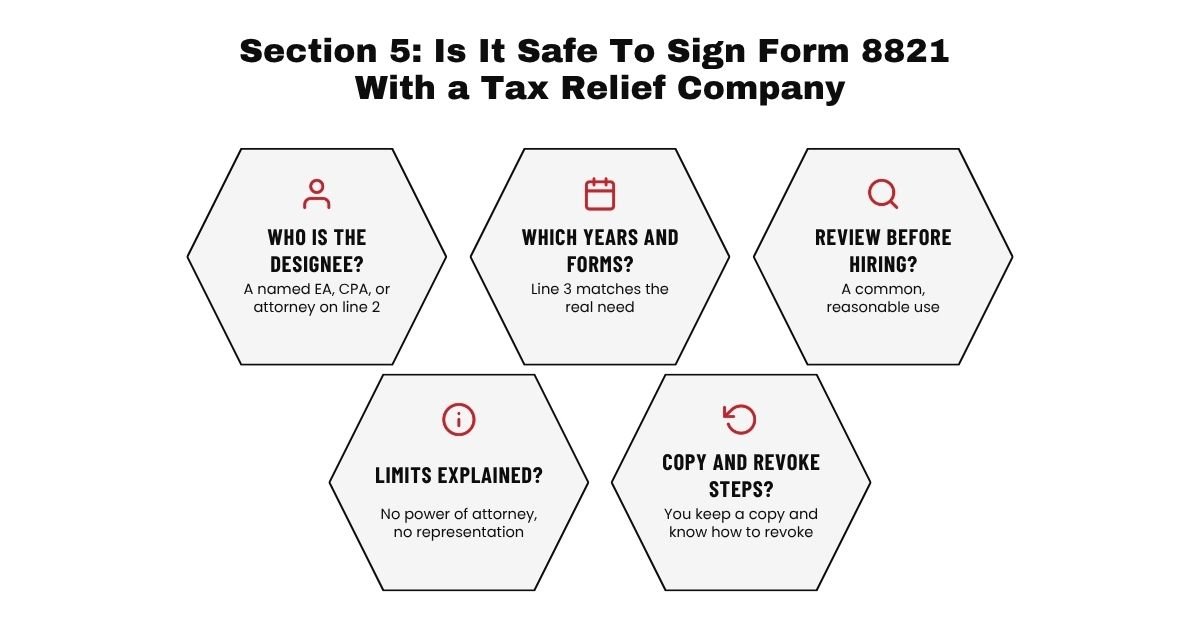
Section 5: Is It Safe To Sign Form 8821 With a Tax Relief Company
A very common question I get is
Is it safe to sign Form 8821 with a tax relief company
My view, Form 8821 is designed with built in limits and protections, however the real risk depends on who holds that access and what they do with it.
What the law requires
IRS rules under Internal Revenue Code section 6103 c restrict how your information can be used and re shared.
Unauthorized use or disclosure can lead to civil penalties and, in serious cases, criminal penalties.
Practical safety checklist before signing
If you are thinking about signing IRS Form 8821 for tax transcript access only, ask these questions
Who exactly will be listed on line 2 as the designee
Is it a named EA, CPA, or attorney, or only a generic company name
Which years and tax forms are listed on line 3
It should match the real need, for example, Form 1040 for tax years 2017 through 2024, not all years and all taxes
Are they using it only to review your IRS account before you hire them
That is common and usually reasonable
Do they clearly explain that Form 8821 does not give power of attorney or full IRS representation
If they blur this line, that is a concern
Do they give you a copy and show you how to revoke Form 8821 later
If a firm hides the form, rushes you, or pushes you to sign paperwork you do not understand, step back
Form 8821 is simply a tool. How safe it is depends on who is holding it and how clearly the limits are explained.
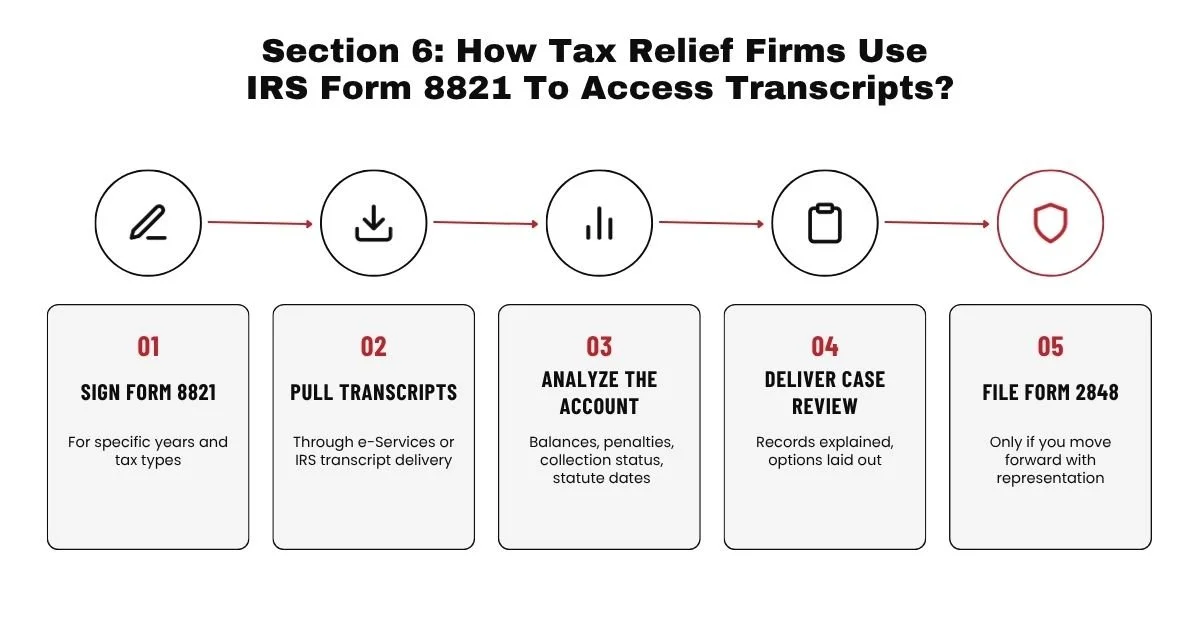
Section 6: How Tax Relief Firms Use IRS Form 8821 To Access Transcripts?
Here is the typical pattern for a legitimate tax relief firm using Form 8821
You sign Form 8821 for specific years and tax types
The firm pulls IRS transcripts and account history through e Services or the IRS transcript delivery system
They analyze
Balances by year
Penalties and interest
Collection status, such as notice status, active collections, or currently not collectible
Statute dates, estimated Collection Statute Expiration Dates
They deliver a written or verbal case review that explains
What the IRS records show
Potential options, such as installment agreement, Offer in Compromise, currently not collectible, penalty relief, and so on
If you decide to move forward, they then file Form 2848 to provide full IRS representation
This is exactly how I use it in my own practice, Form 8821 for diagnostics, Form 2848 for representation.

Section 7: Step by Step Guide To Completing IRS Form 8821
Always use the latest revision of the form from the official IRS site.
Line 1, Taxpayer Information
Enter your legal name exactly as shown on your tax return
Enter your Social Security Number or Employer Identification Number and your mailing address
For joint filers, each spouse must file a separate Form 8821 if both want to authorize someone
Line 2, Designee
Enter the full name and address of the individual or organization you are authorizing
Enter the CAF number if they already have one, if they do not, they can write the word none and the IRS will assign one
If you want them to receive copies of IRS notices, check the box under their name, you can list up to two designees

Section 8: How Long Form 8821 Lasts and How To Revoke It
Duration
The IRS does not set a simple fixed expiration date for every Form 8821. Instead, the authorization remains effective for the specific years and periods listed until
You revoke it in writing or by filing a new 8821 that revokes it
The IRS system eventually purges very old authorizations from CAF
For some non tax matter uses, like lender income verification, Form 8821 usually must be received by the IRS within 120 days of the date you sign.
How to revoke or withdraw Form 8821
You can revoke IRS Form 8821 in two main ways
File a new Form 8821
Use the same line 3 tax information, mark the lines related to revocation as described in the instructions
Send a written revocation to the IRS office where the original form was filed, that letter should state
That you revoke the prior 8821
The designee name
The tax types and years covered
Your signature
You can also update a designee address by written notice without filing a brand new 8821.
Line 3, Tax Information, this line sets the scope
This is where you control what your limited authority form actually covers
Column a, type of tax, for example, income
Column b, form number, for example, 1040
Column c, specific years or periods, for example, 2019 through 2024
Column d, any specific information you want them to receive, for example, account transcripts and balance due information
Important points
Do not write all years or all taxes, the IRS will reject the form
You can include future years, but the IRS will not record more than three future years beyond the year they receive the form
You can also check the box to authorize use of intermediate service providers, third party transcript retrieval software. If you leave it blank, your designee must pull transcripts directly from the IRS systems
Line 4, Specific Use Not Recorded on CAF
Check this box only if Form 8821 is for a one time, specific use that the IRS will not record in its CAF system, such as some lender requests or background checks or specific forms like SS 4, W 2, or W 7.
For ongoing tax debt or tax relief cases, we usually do not check this box. We want the authorization on CAF so IRS personnel can see it.
Line 5, Retention or revocation of prior authorizations
If line 4 is not checked, the default rule is
A new Form 8821 automatically revokes all prior Forms 8821 on file for the same tax matters and years, unless you attach copies of prior forms you want to keep
Use line 5 to keep specific older 8821 authorizations in place by attaching copies.
Line 6, Signature of taxpayer
Sign and date the form
For entities, the signer must have proper authority, such as officer, partner, trustee, or executor
How to file Form 8821
You can file Form 8821 in a few ways
Online, by uploading securely through the IRS Form 8821 submission portal, which requires a Secure Access account
Fax or mail, using the addresses in the instructions, typically the CAF units in Ogden or Memphis, or a specific office if line 4 is checked

Section 9: Using IRS Form 8821 Before Hiring a Tax Pro
Many taxpayers want to see the damage before they commit to a full representation engagement. Form 8821 is perfect for that.
A common flow looks like this
You sign Form 8821 for the years you are worried about
The tax pro pulls transcripts and builds a year by year breakdown of
Balances
Penalties
Filing compliance
Statute dates
You receive clear options and likely timelines
Then you decide whether you want formal IRS representation with Form 2848
It gives you a clear picture first, before you sign a larger agreement.

Section 10: Common Mistakes When Filing IRS Form 8821
Here are common mistakes I see in real tax relief and tax debt cases
Using vague language like all years or all taxes
The IRS will reject the form, you must list specific tax types, forms, and years
Authorizing too many years just in case
You can always file another 8821 later, over authorizing exposes more data than needed
Forgetting to check the box for notices when you actually want the designee to see them
If you want your tax professional to receive IRS letters at the same time you do, you must check the box on line 2
Forgetting to attach prior Forms 8821 you want to keep
If you do not use line 5 correctly, a new 8821 can automatically revoke earlier authorizations for the same years
Mixing up Form 8821 with Form 2848
Some people sign 8821 and assume they now have IRS representation, then ignore IRS notices, this is dangerous. Remember, Tax Information Authorization is not Power of Attorney
Not limiting access to the correct taxpayer or entity
For business owners, be clear whether you are authorizing access for yourself personally, your LLC or S corporation, or both. Each may require its own form
Section 11: Real World Case Snapshots
Case Snapshot 1, Do I really owe that much
A self employed contractor was told over the phone that he owed more than two hundred thousand dollars. He was not sure if that was accurate.
We
Filed Form 8821 for the past ten years of 1040 income tax
Pulled account transcripts, wage and income, and penalty data
Found that a large part of the balance came from estimated penalties on unfiled years, not actual assessed tax yet
With that information, we mapped out
Which returns had to be filed first
How much of the balance could change
Whether an Offer in Compromise was realistic
All of this happened before filing a power of attorney.
Case Snapshot 2, Is this tax relief company legit
A taxpayer had already signed Form 8821 with a call center style tax relief company but felt uneasy.
We reviewed their 8821 and saw
It covered many more years than she thought she authorized
The firm had authorized intermediate service providers for transcript access
She revoked that 8821 and filed a new, narrow Form 8821 with us.
Once we pulled transcripts and laid out everything in writing, she could compare our plan and pricing with what she had been promised over the phone.
Form 8821 allowed a clean second opinion without giving anyone full IRS representation.
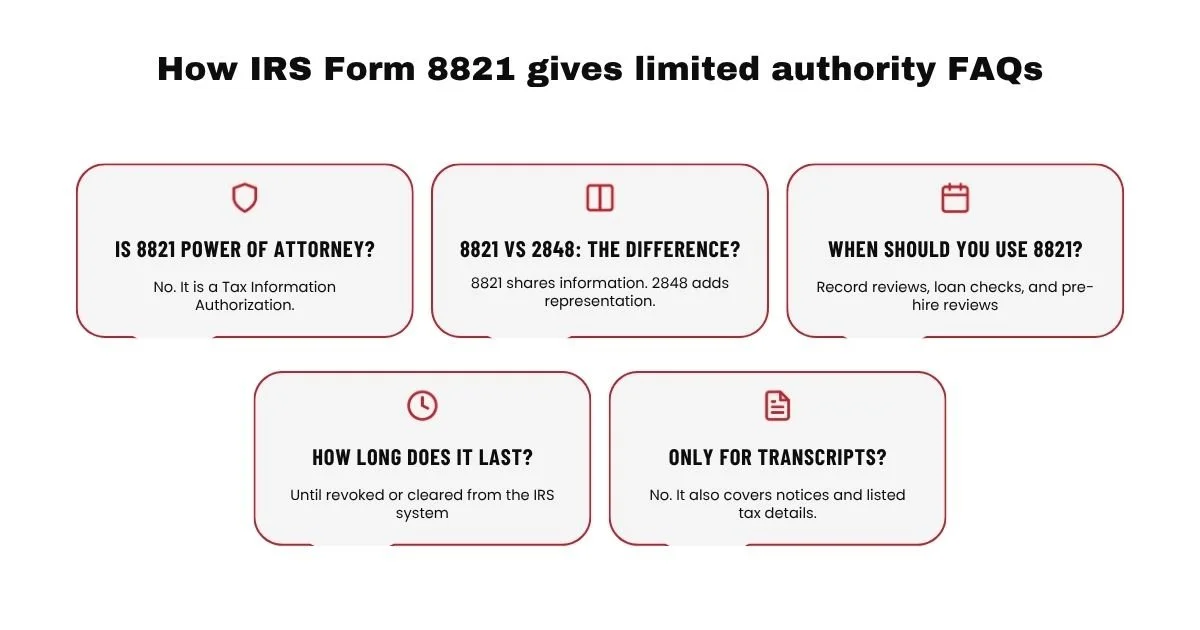
How IRS Form 8821 gives limited authority FAQs
-
No. Form 8821 is a Tax Information Authorization. It does not allow representation or advocacy before the IRS.
-
Form 8821, lets someone inspect and receive your confidential tax information
Form 2848, lets someone both represent you before the IRS and receive your information
-
Use Form 8821 when you
Want a tax professional or lender to see your IRS records
Need transcript based verification for a mortgage, SBA loan, or business lending
Want a tax relief firm to review your account before you decide to hire them
Use Form 2848 when you need full IRS representation for audits, collections, Appeals, or negotiations.
-
It usually lasts until you revoke it or until the IRS system clears it, for the specific years and tax types listed. Some non tax uses require the IRS to receive the form within 120 days of your signature date.
-
Yes. You can revoke Form 8821 by
Filing a new 8821 that revokes prior authorizations, or
Sending a written revocation to the IRS with enough detail to identify the prior authorization
-
No. That is a common use, but it also covers other account level details, notices, and specific tax information you list in line 3.
Conclusion.
Form 8821 is a powerful information only authorization. Used correctly, it helps
You see your IRS situation clearly
Your tax professional perform a thorough review
Everyone stay honest about who can, and cannot, speak for you at the IRS
At the same time, it is still a legal authorization involving your confidential tax records. This guide is educational, it does not replace a one on one review of your actual IRS transcripts, letters, or forms.
If you want to go further, the next step can be a simple checklist or worksheet you can hand to prospects that explains, in plain English
What happens when they sign Form 8821 with your firm
What you can do with 8821
What you cannot do until they sign Form 2848